Click on image to open full size.


Gerard Dillon (1916-1971)
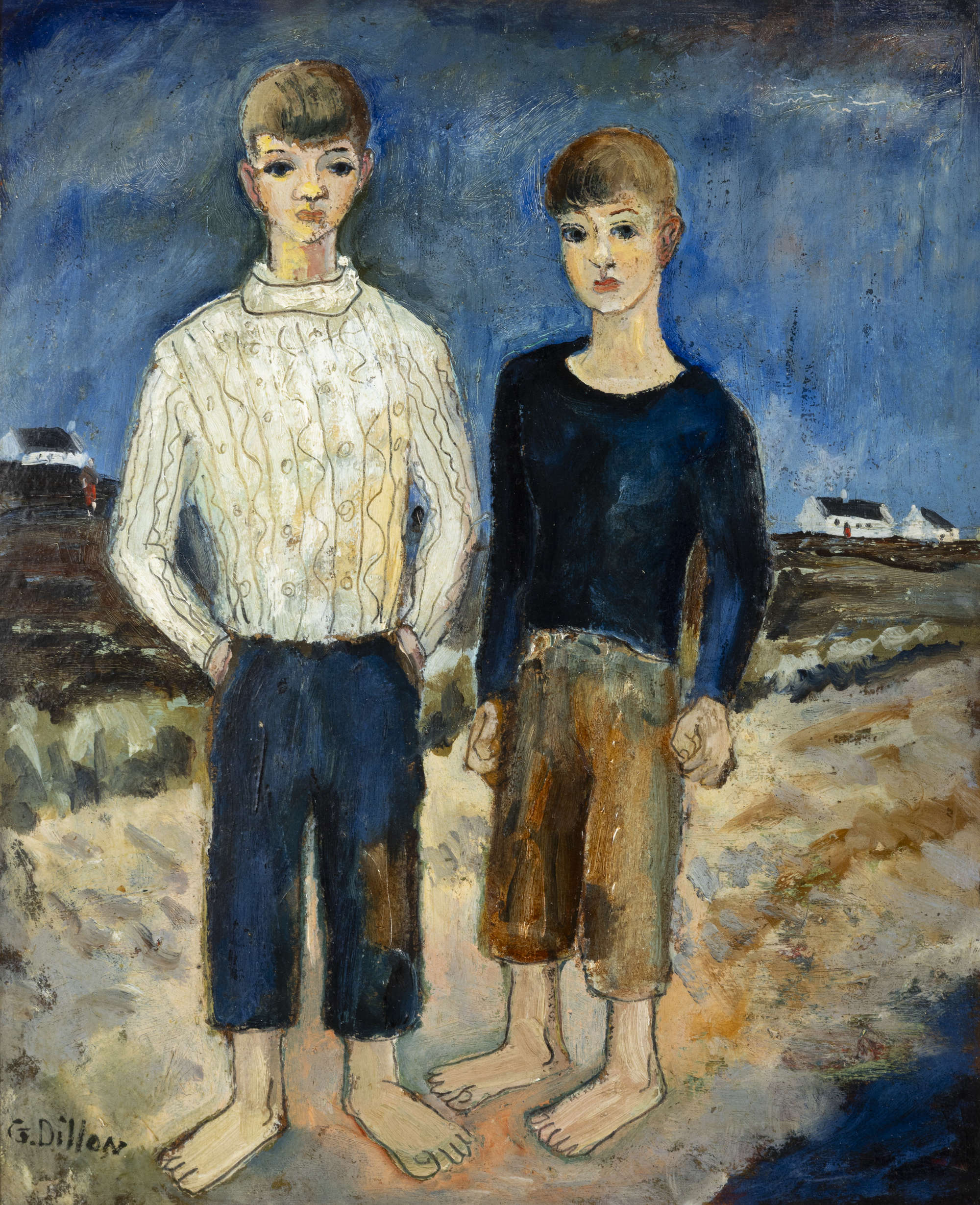
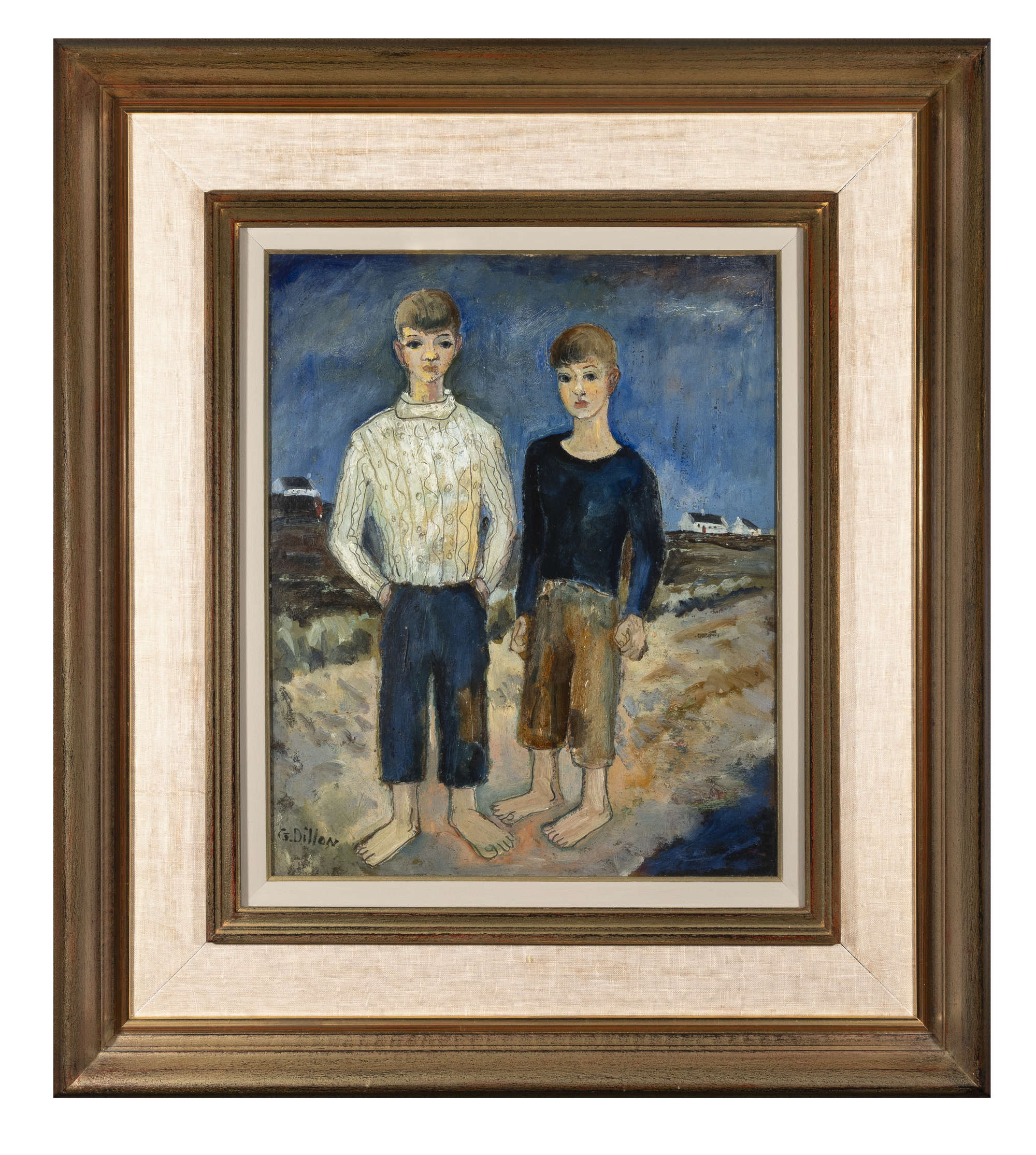
Inishmore Lads
Oil on board, 40 x 32.5cm (15¾ x 12¾")
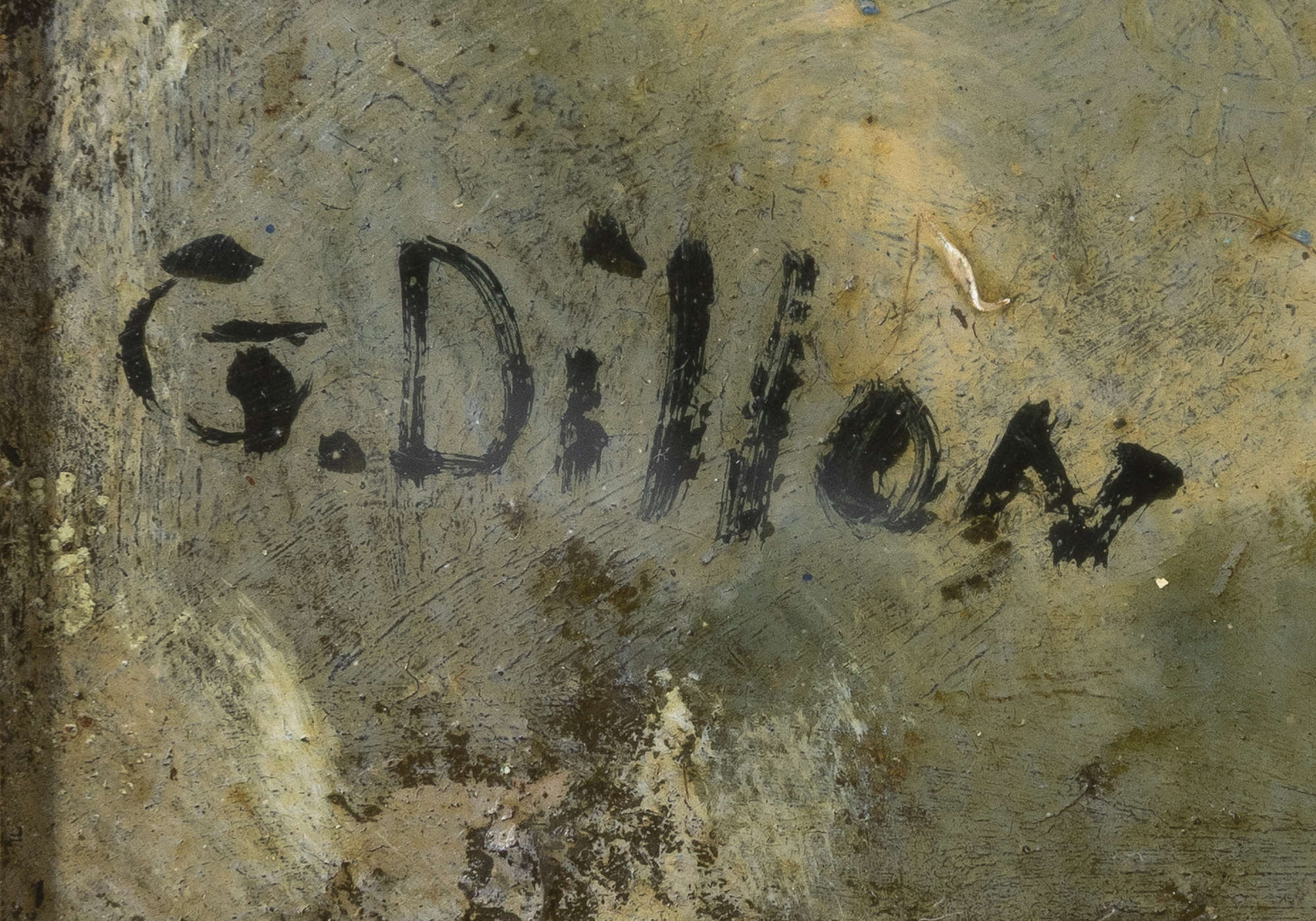
Signed
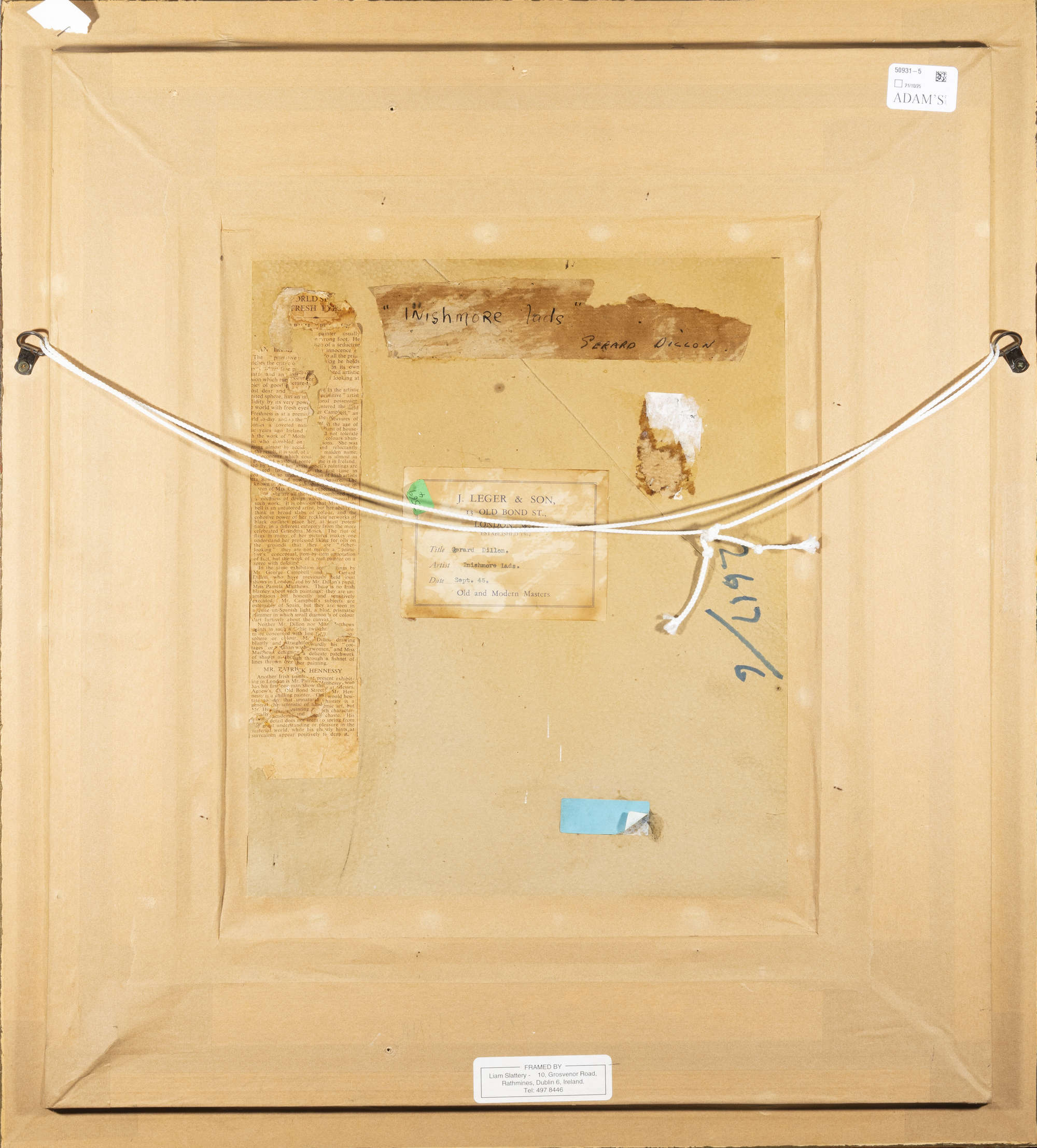
Provenance: with J. Leger & Son, 13 Old Bond St., London, September 1945, gallery label verso; Private...
Gerard Dillon (1916-1971)
Inishmore Lads
Oil on board, 40 x 32.5cm (15¾ x 12¾")
Signed
Provenance: with J. Leger & Son, 13 Old Bond St., London, September 1945, gallery label verso; Private Collection, Dublin
A newspaper cutting on the back of the painting reviewing the exhibition in London reflects on the Irish artists work which included Dillon, George Campell, Patrick Hennessy and Pamela Matthews. ‘There is no Irish blarney about such paintings, they are unambitious but honestly and sensitively executed.’ And of Dillon's work more directly ‘Mr Dillon drawing bluntly and straightforwardly.’
During the 1950s, depictions of the more ‘isolated’ West of Ireland were well received by critics and buyers alike. The paintings suggested, at least to the outside viewer, that these landscapes and communities were untouched by the more modern ideals and practices in other parts of Ireland. Thus, the culture came to stand for a lost ‘Irishness’ that was pined for by the romantics.
However, Dillon and some other artists of the period, strived for that sense of straightforwardness and honesty in their depictions. Particularly in his portraits of island people, he expresses a deep respect for them. In the works, while the locals who modelled for his portraits seem somewhat uncertain of the artist, as a stranger in their community, Dillon also evokes their keen sense of independence and self-reliance which was learned from a young age.
The two young men, possibly brothers, stand barefoot, wearing short cropped trousers and woollen jumpers. They adopt slightly different positions, the older boy more relaxed with his hands in his pockets, the other more awkward and self-conscious, his hand curled into fists with nervous energy. They stand along the shore line, with fields in distance and white washed thatched stone cottages dotting the horizon line. This work is reminiscent of another islander portrait by Dillon Moonstruck Youth (sold these rooms, 2019) who also stands before an inky blue moonlit sky.
Clothes were made by hand, passed down between siblings, shared and mended as is evident on the older boy’s blue trousers with a brown square patch on the knee. The traditional woollen jumpers were knitted by women on the island, mothers, sisters and wives of the young men to wear while out fishing on the Atlantic. The patterns functioned as a distinct identifier of different communities on the islands. The traditional woven pattern on the figures’ white jumper, of stripes and swirls is created by Dillon using the pointed end of the brush, scraping into the paint and heightening both the material handmade quality of the clothing and the physical quality of the painted surface.
Niamh Corcoran, October 2025
All bids are placed in Euros (€)
Please note that by submitting a bid you are agreeing to our Terms & Conditions


 Have a similar item to sell?
Make Enquiry
Have a similar item to sell?
Make Enquiry