Click on image to open full size.


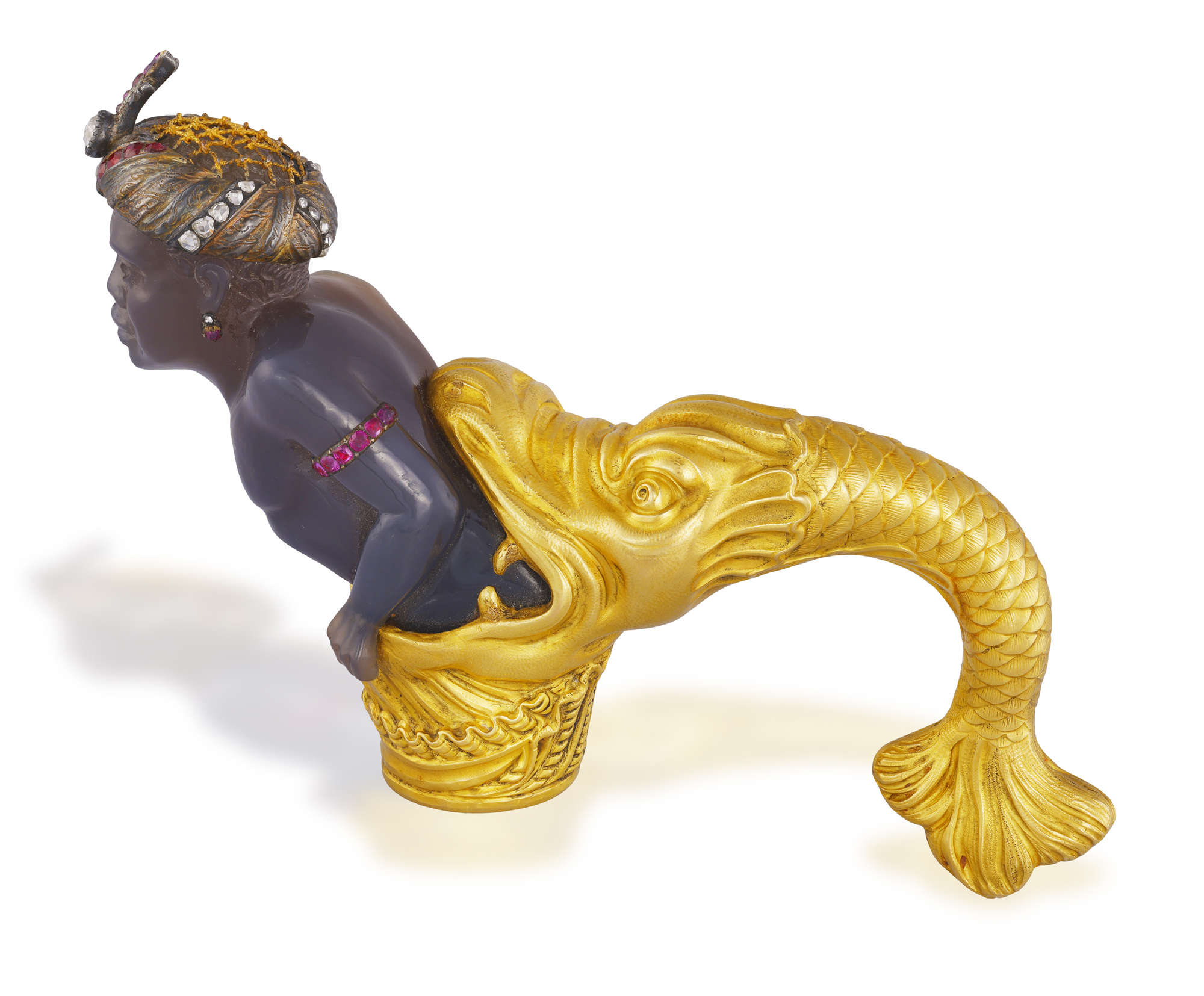
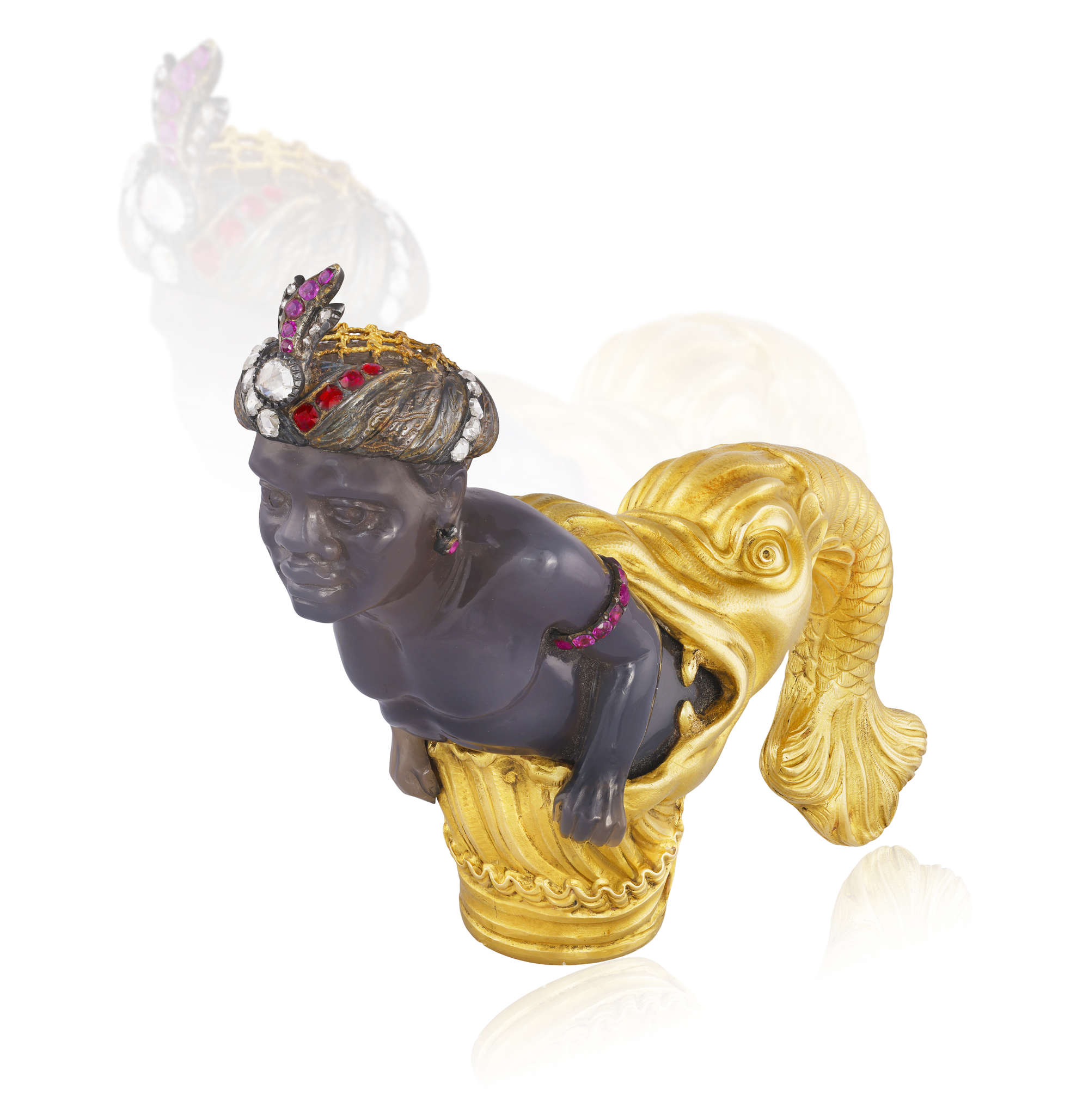
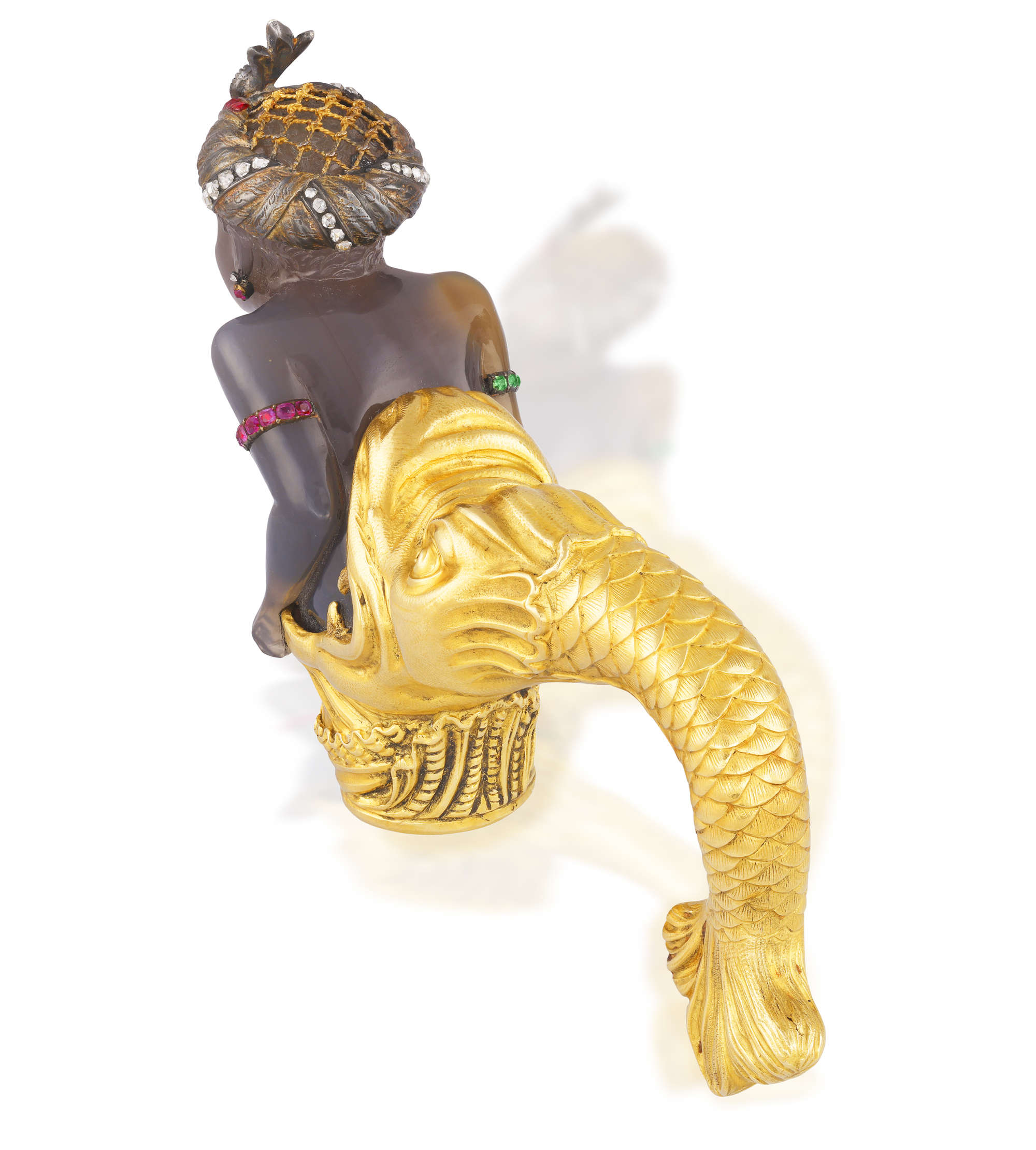
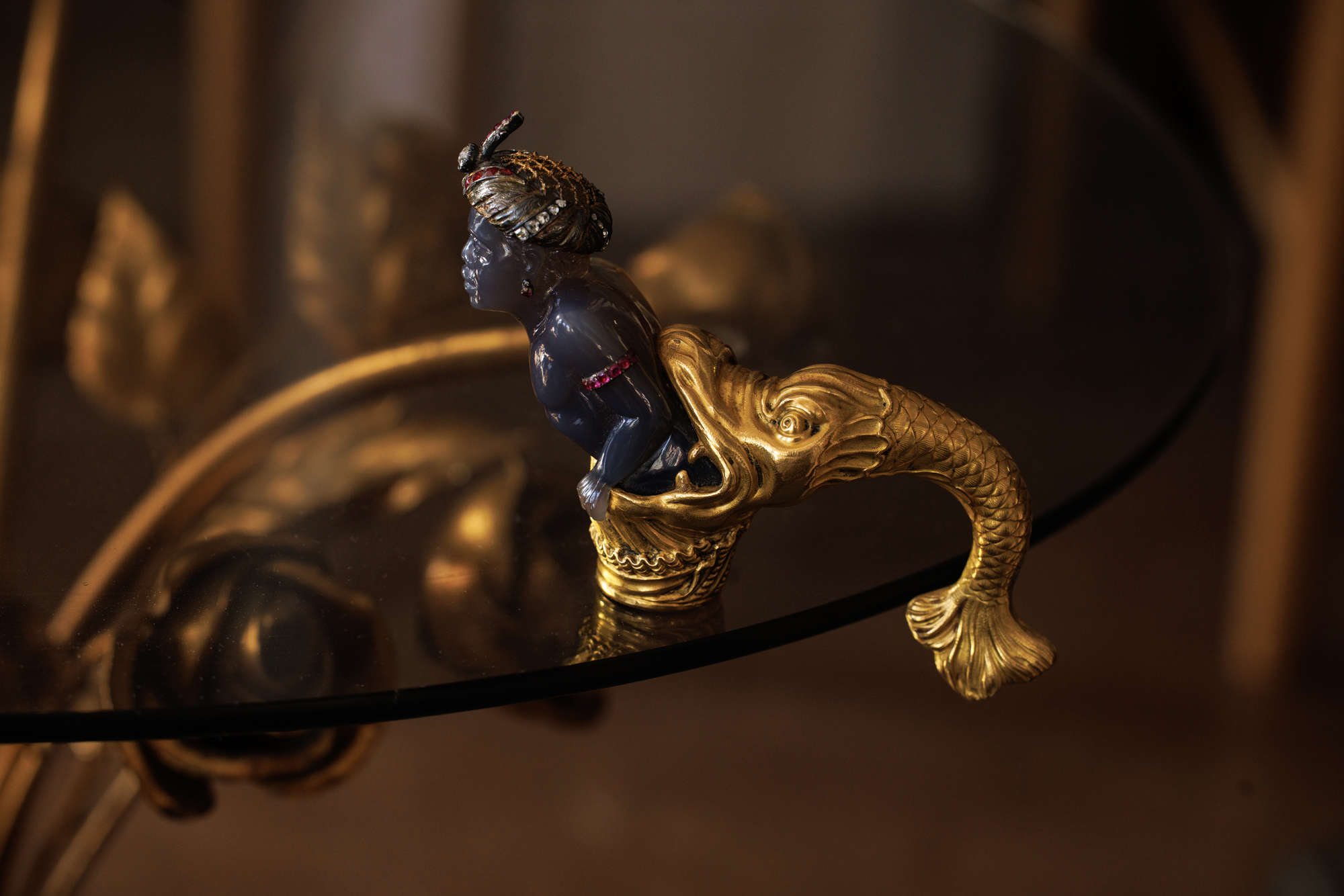
A RARE & COLLECTIBLE 18TH CENTURY HARDSTONE AND GEM-SET CANE HANDLE
Private Collection from a descendant of the Armour Family (lot 40 to 58)
The gold handle modelled as a stylised daulphin figure,...
A RARE & COLLECTIBLE 18TH CENTURY HARDSTONE AND GEM-SET CANE HANDLE
Private Collection from a descendant of the Armour Family (lot 40 to 58)
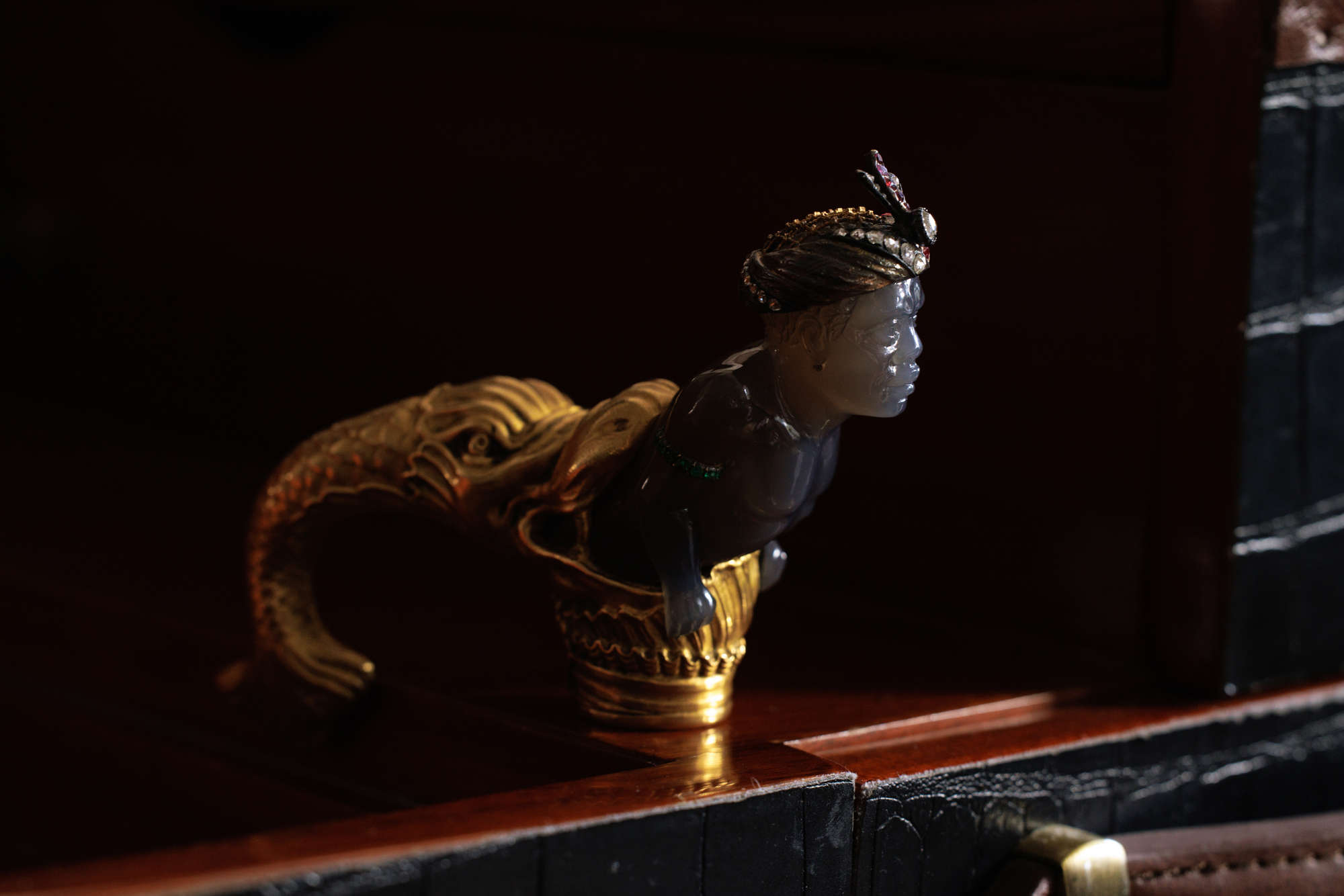
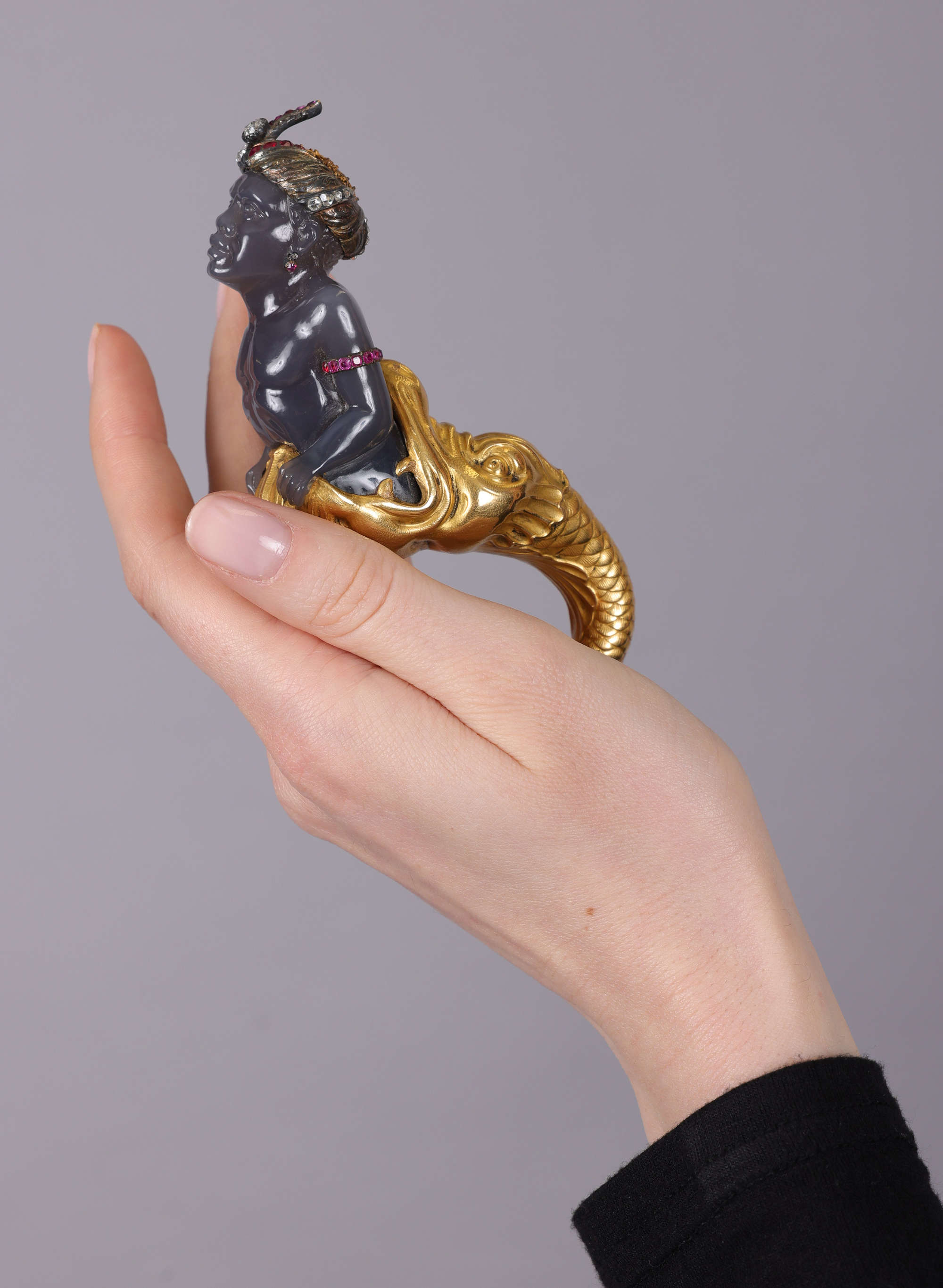
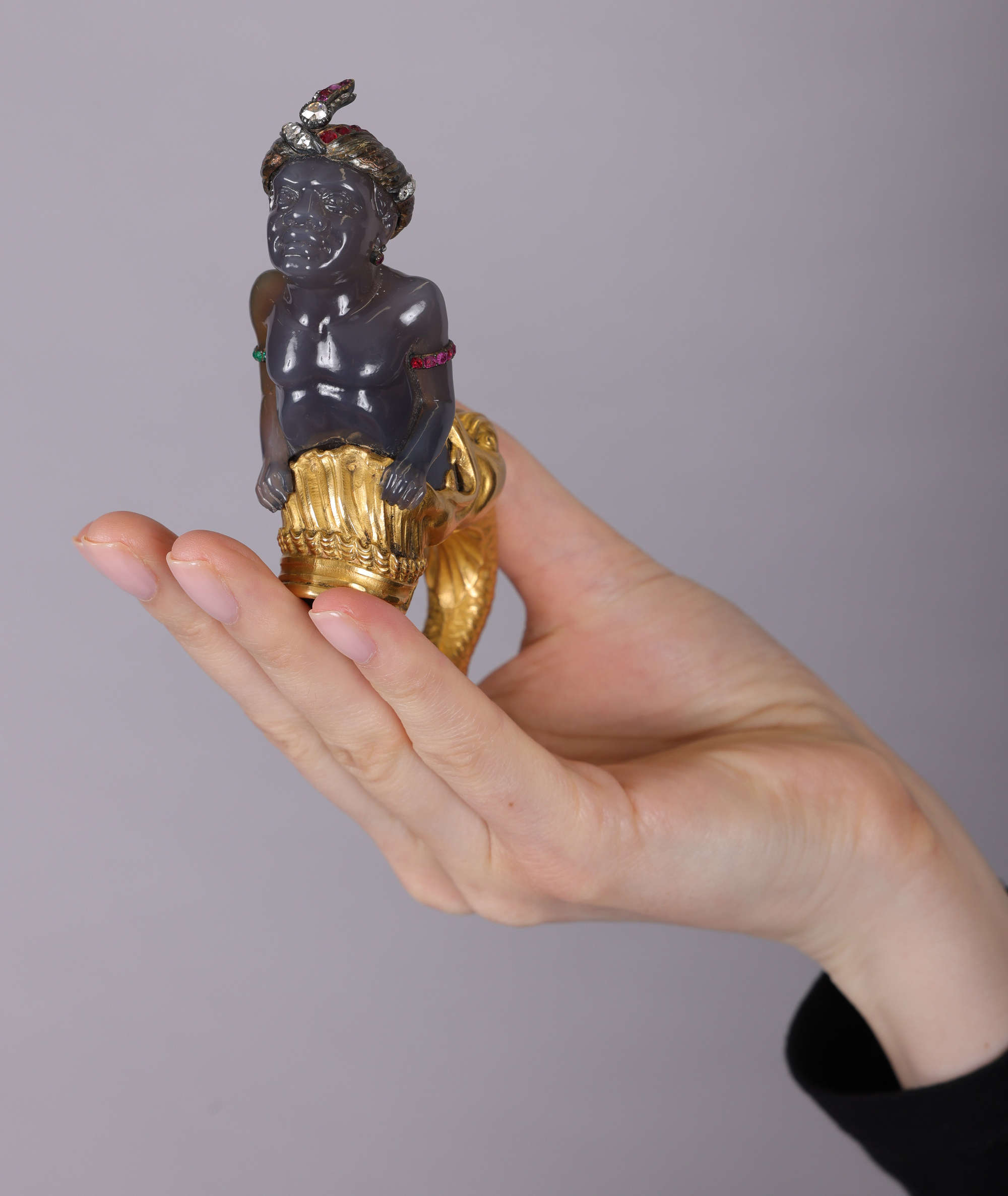
The gold handle modelled as a stylised daulphin figure, from whose wide-open jaws emerges a carved agate Zamora leaning with both hands on a shell, with a stylised gold turban embellished with rose-cut diamonds and old cushion-shaped rubies, wearing similarly-cut ruby earrings and with emerald and ruby arm bracelets, dimensions approximately 10.5 x 8cm
An almost identical cane handle was exhibited at the Moscow Kremlin Museum in 2021, at the exhibition 'France & Russia. Ten Centuries Together", and is dated 1750-1751, Paris.
The piece exhibited was described as:
"This piece was among the items in the display case of Louis XVI’s reception room in the Winter Palace and belonged to the imperial family. The hilt was exhibited in 1904 at the Historical Exhibition of Works of Art, which took place in the Grand Exhibition Hall at Baron Stieglitz’s school in St. Petersburg, and was listed in the catalogue as “a pommel with a stone head of Zamora, formerly belonging to the Count and Countess de Dubarry.” Subsequently, this information appeared in the Inventory of the Armory Chamber with a comment by museum director Dmitry Dmitrievich Ivanov: “According to legend, it belonged to Countess Dubarry and depicts her favourite, Zamora, but this legend does not correspond to the age of the depicted Black man.”
The work is dated according to the hallmark of the Paris Goldsmiths’ Guild.
Cane handle. France, 1750s. Width: 11.7 cm; height: 11.2 cm.
View: https://t.me/kremlinmuseums/6017
Philip Danforth Armour Sr. (1832-1901) born in upstate New York was an industrialist and a 'founding father' in 1867 of the renowned Chicago meatpacking firm, Armour & Company. Philip's financial success began during the California gold rush (1852-1856). These proceeds were used to start up a wholesale soap business in Cincinnati and then in Milwaukee. Philip was a key figure in America's gilded age during the second half of the 19th century. The newly formed railroads connecting the country was the primary catalyst for industrialisation, gigantic economic growth, and mass immigration to America. In turn this lead the way for big business to establish modern management techniques. Armour & Company were a pioneer for the innovation of the assembly-line techniques in its factories. This process allowed for almost every part of the animal to be used, making use of 'everything but the squeal'. This created the consumer by-products such as glue, soap, pharmaceuticals and fertiliser. Also, it was the first company to be able to produce canned meat and transport raw meat using the newly introduced refrigerated railcars. The success of the firm resulted in becoming the world's largest food processing and chemical manufacturing company, headquartered in Chicago. Philip married in 1862 to Malvina Belle Ogden (1842-1927). Philip's legacy was to donate a substantial sum to the then Armour Institute now Illinois Institute of Technology. In his honour the Union Pacific Railroad use the 'Armour Yellow' on their refrigerated cars to this day.
Philip and Malvina's eldest son Jonathan Ogden Armour (1863-1927), known as J. was not supposed to inherit the family's meatpacking dynasty. Sadly, his younger brother Philip Danforth Armour Jr. predeceased his father in 1900. J. Armour became the owner and president of Armour & Company and grew the company significantly. However, the company lost millions in the post first world war slump between 1919 - 1921 and the family fortune dissipated. In 1891, J. married Lola Hughes Sheldon (1869-1953). When J. died in 1927 there was not much left in the estate. However, the remaining stocks in the Universal Oil Products Company passed to Lola. Lola or 'Lolita' had shrewd financial judgement and invested the capital in commercial real estate. She was politically savvy and kept up correspondences with several US presidents, Congressmen and top political figures of her day. Lola was known for her jewellery collection, so much so, she was robbed by Al Capone's men. Locked in a cupboard as the jewellery was taken, her powerful demeanour was not going to put her off from requesting the sentimental pieces to be put back. It proved to work as the robbers obliged.
Their daughter Lolita Armour (1896-1976) was born premature and subsequently formed congenital dislocation of both hips.
Lolita's parents invited Adolf Loren, an Austrian orthopaedic surgeon and professor at the University of Vienna to help assist with her condition. The operation and rehabilitation were an apparent success. Lolita went on to marry in 1922, John 'Jack' Mitchell Jr. (1897-1985), the son of the president of the Illinois Trust and Savings Bank. Jack co-founded National Air Trans-port, which later became United Airlines. They spent their time between Chicago, El Mirador in Montecito and their 12,000 acre ranch in the Santa Ynez Valley. It was at El Mirador, where Lolita and Jack transformed the grounds into one of the most fabulous estates in the area. Jack established Los Rancheros Visitadores or the Visiting Ranchers', a social club for riders with an annual trek across the terrain.
The family have since passed on through the generations and moved countries. These rediscovered unique pieces bring back to life the story of an old American dynasty, the Armour family.
When virtue was something you could hold in the palm of your hand..
Long before the eighteenth century, the walking cane carried meaning beyond its function. In the ancient world, it was the attribute of gods and kings; in medieval Europe, the prerogative of pilgrims, bishops, and rulers. By the Renaissance, the carved and gilded cane had become a fixture of court portraiture, held with deliberate ease by princes and ambassadors who understood that how one carried oneself was inseparable from what one carried.
It was in eighteenth-century France, however, that the cane reached its highest elaboration. As sword-wearing declined across the century, the cane stepped naturally into its place as the defining accessory of the fashionable gentleman. It joined the gold snuffbox, the chased watch case, and the jewelled seal in a glittering ensemble through which refinement and social confidence found their most visible expression. By the reign of Louis XV, no self-respecting figure at Versailles would have appeared without one, and contemporary observers noted that a cane could be swung, posed with, and wielded socially with an eloquence almost beyond words.
Particular splendour was reserved for the handle. Here, working on an intimate scale, Parisian goldsmiths and jewellers found scope for virtuosity unconstrained by utility. Gold and silver were the prestige choices, fashioned into rounded, pistol-grip, or tau-shaped pommeaux and enriched with diamonds, rubies, and paste stones. Sèvres porcelain handles carried painted miniatures of pastoral scenes and mythological figures. Hardstones, agate, carnelian, rock crystal, and bloodstone, were worked into smooth, cool knobs that showed the natural beauty of the material to advantage. Ivory and tortoiseshell inlaid with gold piqué work, and lacquer work in the chinoiserie taste that swept France from the 1720s onwards, extended the range still further.
The choice of form was rarely arbitrary. Rococo design thrived on the fantastical, and cane handles offered a natural stage for its vocabulary: dolphins with open jaws, serpents coiled mid-strike, eagles, satyrs, turbaned figures, and creatures drawn from myth and from the edges of the known world. These shapes were not merely decorative caprice. They participated in a broader culture of symbolic display in which an object's form could speak to its owner's erudition, allegiances, or aspirations. The dolphin, for instance, was rich in positive symbolism and served as the heraldic emblem of the Dauphin, heir to the French throne. Marine creatures more generally evoked classical mythology and the mastery of nature. Exotic figures, African or Asian, turbaned and richly adorned, reflected Europe's fascinated and complicated engagement with the wider world, lending an object an air of theatrical luxury while encoding the hierarchies of the age.
The finest handles of this period are best understood not as accessories but as objets de vertu: small sculptures in which utility was elevated by craftsmanship of the highest order. A handle combining chalcedony, chased gold, and gem-set figures demanded precision, imagination, and technical command comparable to that required of a jewelled snuffbox or a mounted hardstone vessel. That such objects were taken seriously by the most discerning collectors of the following century is confirmed by the deep holdings of the Rothschild collections at Waddesdon Manor, assembled with a connoisseur's appetite for exquisitely wrought small objects in precious materials.
Their international appeal is equally telling. French workshops supplied not only the court at Versailles but a European clientele that extended to the Russian imperial family, and comparable examples survive today in the Armory Chamber of the Moscow Kremlin Museums, where a French handle of the 1750s, bearing the hallmark of the Paris Goldsmiths' Guild, once stood in Louis XVI's reception room in the Winter Palace. Further examples are held by the Victoria and Albert Museum, the Metropolitan Museum of Art, and the Musée des Arts Décoratifs in Paris.
Together, these survivals affirm the cane handle as one of the more eloquent objects of its age: a thing designed above all to be seen and admired.
All bids are placed in Euros (€)
Please note that by submitting a bid you are agreeing to our Terms & Conditions


 Have a similar item to sell?
Make Enquiry
Have a similar item to sell?
Make Enquiry