Click on image to open full size.


AN EARLY 20TH CENTURY PEARL AND DIAMOND RING
Private Collection from a descendant of the Armour Family (lot 40 to 58)
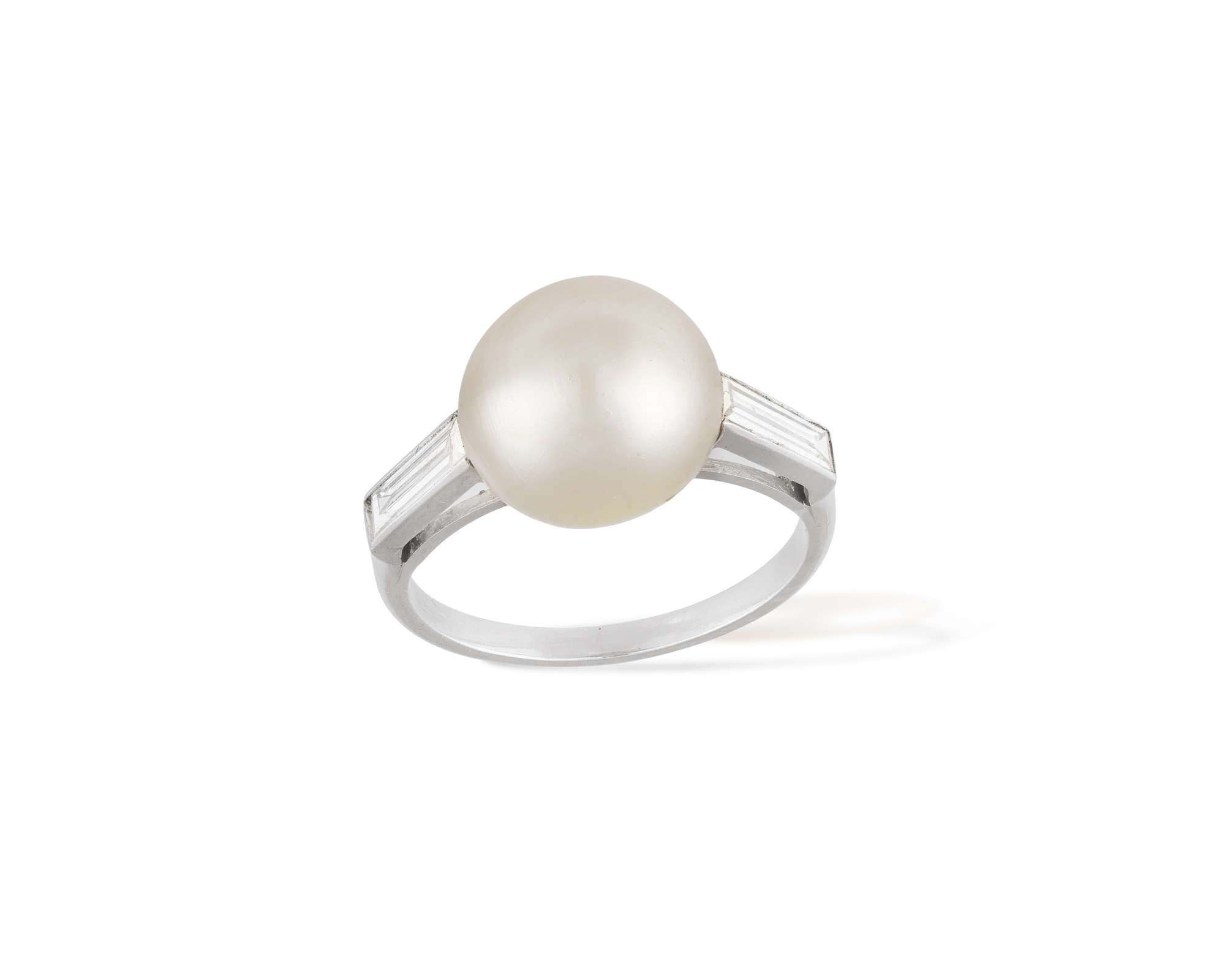
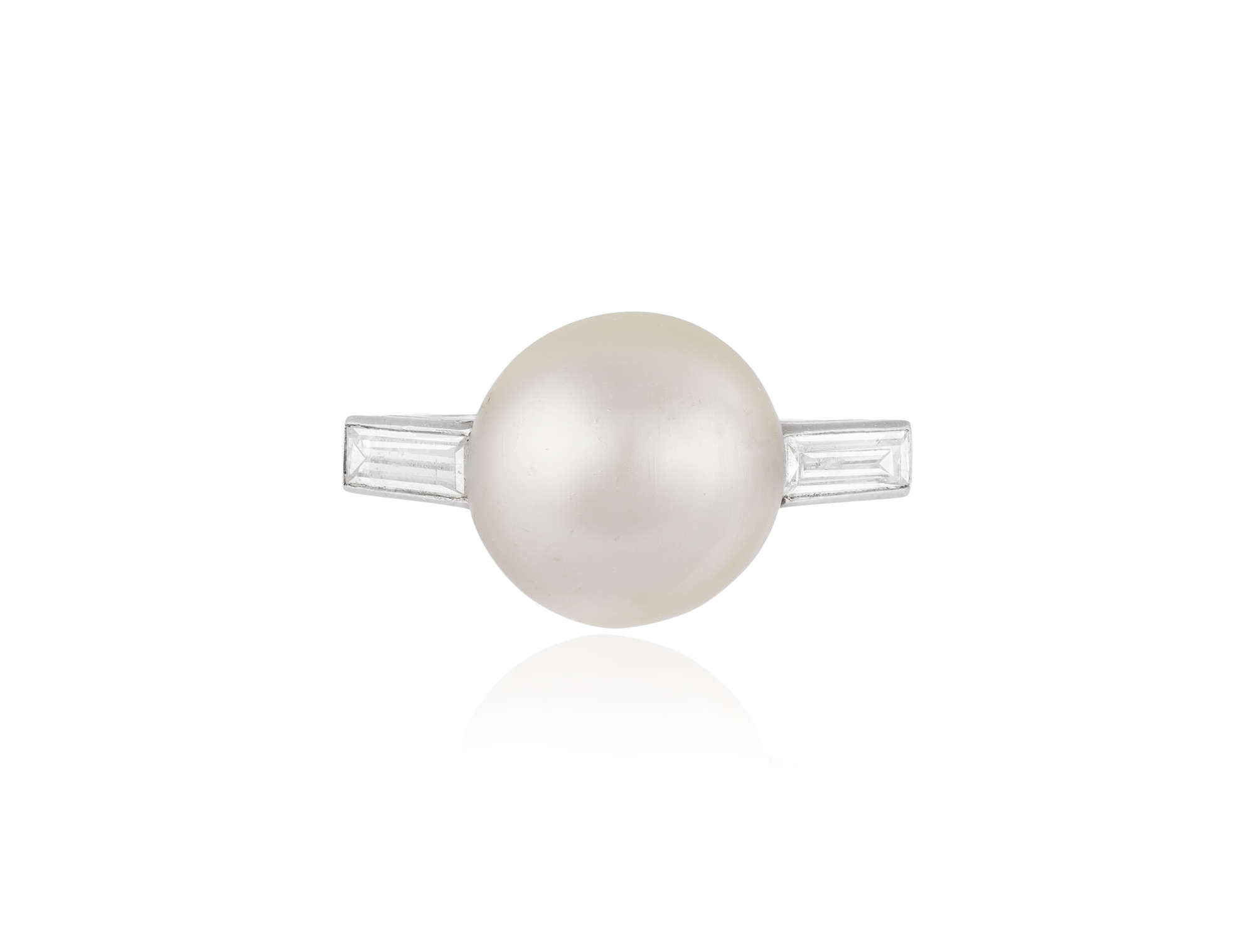
The central button-shaped pearl, between baguette-cut diamond shoulders,...
AN EARLY 20TH CENTURY PEARL AND DIAMOND RING
Private Collection from a descendant of the Armour Family (lot 40 to 58)
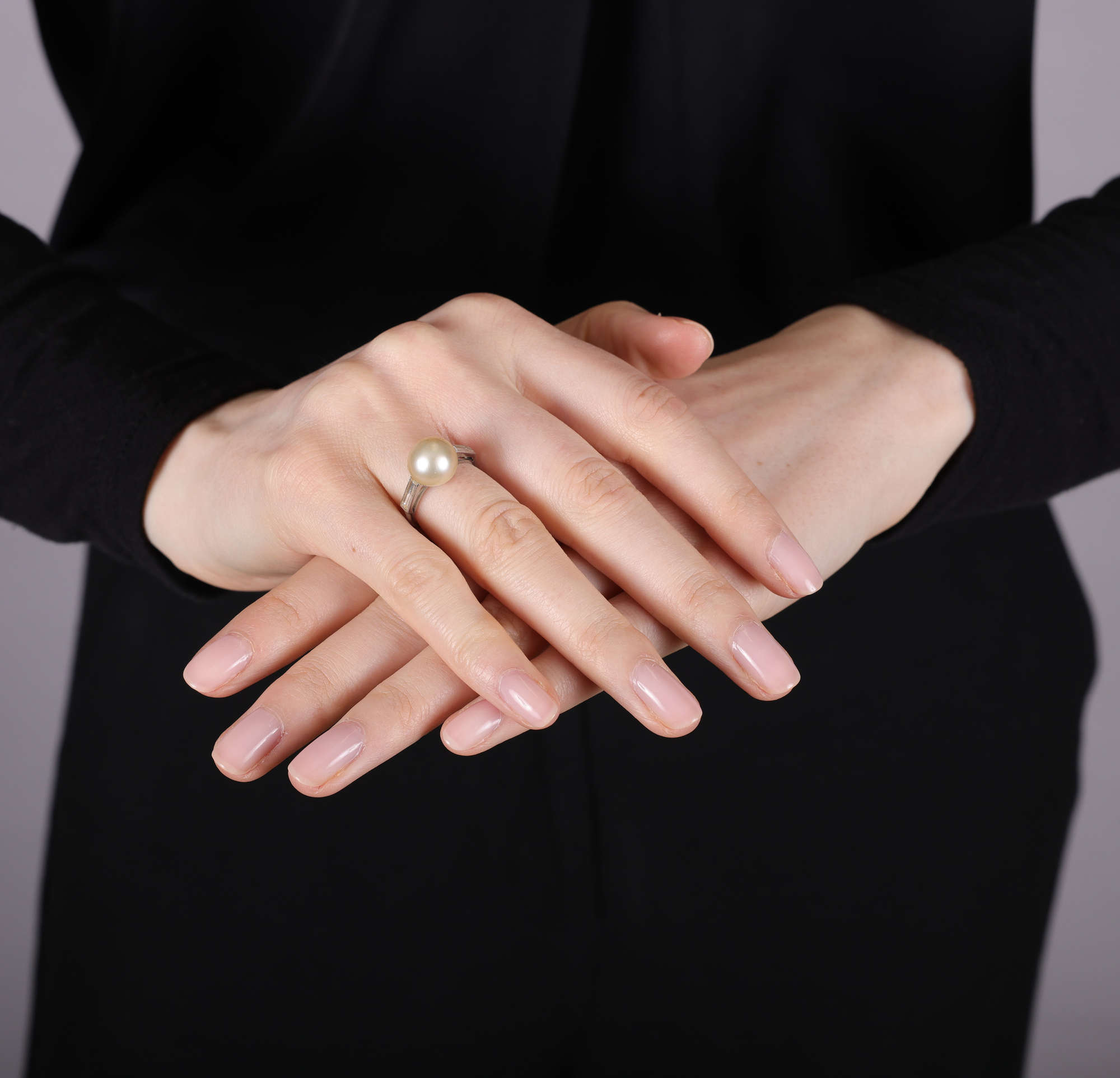
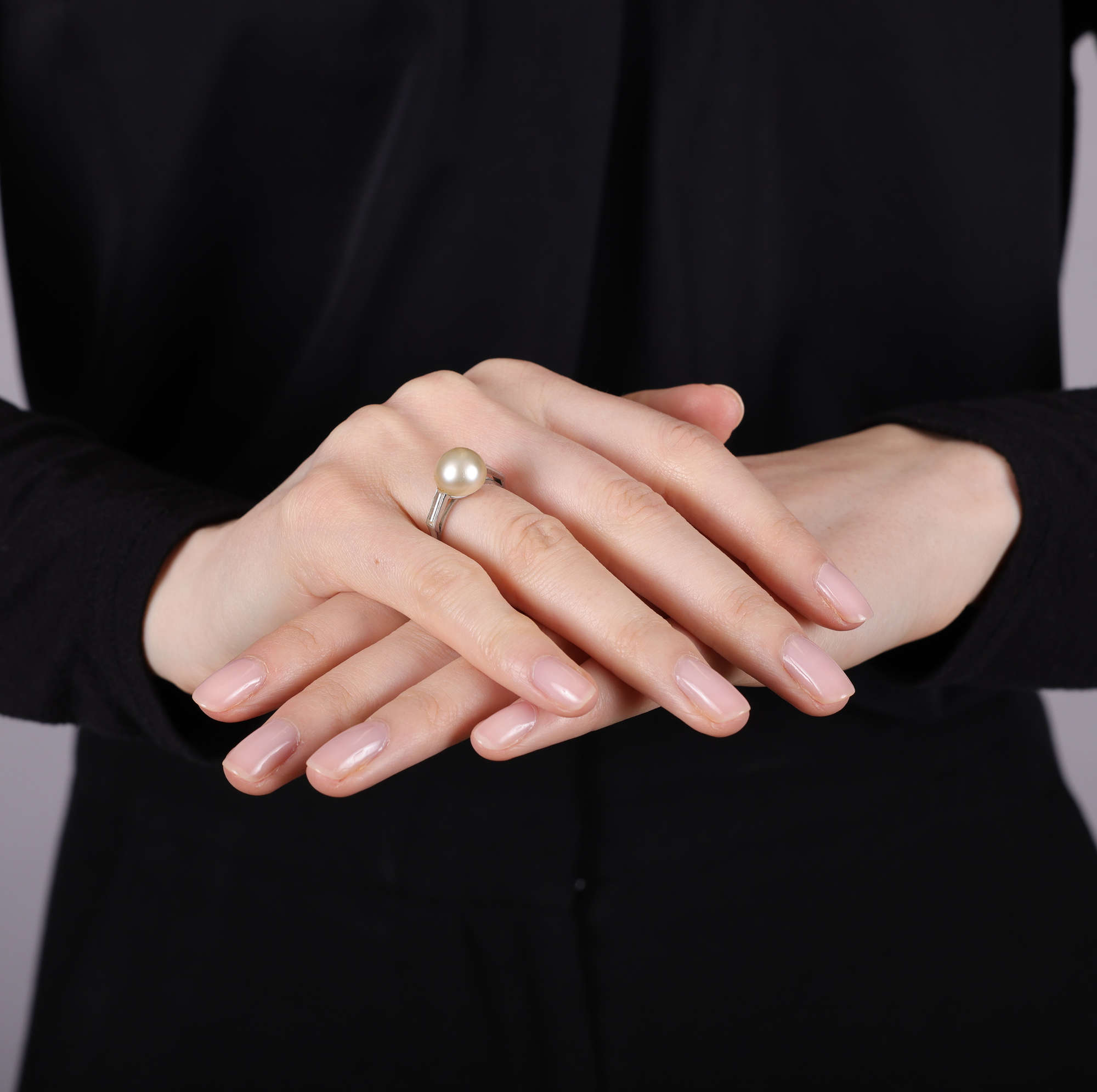
The central button-shaped pearl, between baguette-cut diamond shoulders, mounted in platinum, diamonds approximately 0.60ct total, ring size I
Accompanied by a report from GCS laboratory in London, stating that the pearl, measuring approximately 10.3 x 10.3 x 8.0mm, is natural, saltwater, with no indications of treatment. Report no. 5786-2439, dated April 17th 2026.
Philip Danforth Armour Sr. (1832-1901) born in upstate New York was an industrialist and a 'founding father' in 1867 of the renowned Chicago meatpacking firm, Armour & Company. Philip's financial success began during the California gold rush (1852-1856). These proceeds were used to start up a wholesale soap business in Cincinnati and then in Milwaukee. Philip was a key figure in America's gilded age during the second half of the 19th century. The newly formed railroads connecting the country was the primary catalyst for industrialisation, gigantic economic growth, and mass immigration to America. In turn this lead the way for big business to establish modern management techniques. Armour & Company were a pioneer for the innovation of the assembly-line techniques in its factories. This process allowed for almost every part of the animal to be used, making use of 'everything but the squeal'. This created the consumer byproducts such as glue, soap, pharmaceuticals and fertiliser. Also, it was the first company to be able to produce canned meat and transport raw meat using the newly introduced refrigerated railcars. The success of the firm resulted in becoming the world's largest food processing and chemical manufacturing company, headquartered in Chicago. Philip married in 1862 to Malvina Belle Ogden (1842-1927). Philip's legacy was to donate a substantial sum to the then Armour Institute now Illinois Institute of Technology. In his honour the Union Pacific Railroad use the 'Armour Yellow' on their refrigerated cars to this day.
Philip and Malvina's eldest son Jonathan Ogden Armour (1863-1927), known as J. was not supposed to inherit the family's meatpacking dynasty. Sadly, his younger brother Philip Danforth Armour Jr. predeceased his father in 1900. J. Armour became the owner and president of Armour & Company and grew the company significantly. However, the company lost millions in the post first world war slump between 1919 - 1921 and the family fortune dissipated. In 1891, J. married Lola Hughes Sheldon (1869-1953). When J. died in 1927 there was not much left in the estate. However, the remaining stocks in the Universal Oil Products Company passed to Lola. Lola or 'Lolita' had shrewd financial judgement and invested the capital in commercial real estate. She was politically savvy and kept up correspondences with several US presidents, Congressmen and top political figures of her day. Lola was known for her jewellery collection, so much so, she was robbed by Al Capone's men. Locked in a cupboard as the jewellery was taken, her powerful demeanour was not going to put her off from requesting the sentimental pieces to be put back. It proved to work as the robbers obliged.
Their daughter Lolita Armour (1896-1976) was born premature and subsequently formed congenital dislocation of both hips.
Lolita's parents invited Adolf Loren, an Austrian orthopaedic surgeon and professor at the University of Vienna to help assist with her condition. The operation and rehabilitation were an apparent success. Lolita went on to marry in 1922, John 'Jack' Mitchell Jr. (1897-1985), the son of the president of the Illinois Trust and Savings Bank. Jack co-founded National Air Trans-port, which later became United Airlines. They spent their time between Chicago, El Mirador in Montecito and their 12,000 acre ranch in the Santa Ynez Valley. It was at El Mirador, where Lolita and Jack transformed the grounds into one of the most fabulous estates in the area. Jack established Los Rancheros Visitadores or the Visiting Ranchers', a social club for riders with an annual trek across the terrain.
The family have since passed on through the generations and moved countries. These rediscovered unique pieces bring back to life the story of an old American dynasty, the Armour family.
Natural pearls were for centuries among the rarest and most coveted treasures on earth.
Unlike other gems, which must be cut and polished to reveal their beauty, the natural pearl emerges from the shell with its lustre already complete. Formed by chance within an oyster or mussel, it was admired not only as a jewel, but as a marvel of nature.
Their significance lay above all in that rarity. Most natural pearls found throughout history were small, often less than a grain in weight, which made the assembling of a well-matched necklace an exceptional achievement and multiple strands rarer still. It was this scarcity, as much as their beauty, that made natural pearls inseparable from wealth, rank and privilege.
The principal historic source of natural pearls was the Persian Gulf, which supplied the world from antiquity until the 1920s. There, hundreds of boats and thousands of divers worked the oyster beds by hand, often at depths of twenty metres or more. Beyond the Gulf, natural pearls also came from southern India, Ceylon, and the rivers of Europe and North America.
For much of history, the natural pearl was a powerful sign of status and refinement. It appears in the royal jewellery of the ancient Persian world, was prized by the Greeks and Romans, and in medieval Europe acquired both regal and sacred significance. During the Renaissance and after, it became central to court display, appearing in portraits of Catherine de’ Medici, Elizabeth I and other rulers as a sign of dynastic wealth and authority.
By the beginning of the twentieth century, fashion favoured ropes and rows of pearls, while fisheries in the Gulf, India, Ceylon and Panama continued to supply royal houses, aristocratic families and the ultra-wealthy. In 1917, their value was so extraordinary that Pierre Cartier acquired the Fifth Avenue mansion in New York from Morton Plant after Plant’s wife, Maisie, fell in love with Cartier’s natural pearl necklaces; the mansion, valued at about $950,000, was exchanged for two natural pearl necklaces valued at $1.5 million, together with $100 in cash.
It is also here that the distinction between natural and cultured pearls becomes essential. In both, the mollusc coats an irritant with nacre, but a natural pearl forms without human intervention, whereas a cultured pearl begins with deliberate human action. In seawater culturing, a bead and a small piece of pearl-producing tissue are inserted into the oyster, which is then returned to the water to grow the pearl under controlled conditions. Natural pearls, by contrast, occur by accident of nature, and it is precisely this that gave them their exceptional prestige.
The commercial success of cultured pearls in Japan soon after the First World War transformed the pearl market. More widely available and competitively priced, they soon eclipsed natural pearls in ordinary jewellery. Yet the rise of cultured pearls did not lessen the appeal of natural pearls; it defined their rarity more clearly than ever.
The fascination of natural pearls is perhaps best expressed through the legendary jewels associated with them. Among the most celebrated were the historic single-strand necklace formerly belonging to Barbara Hutton and the Nina Dyer Necklace, a remarkable three-strand natural black pearl necklace. La Régente passed from Napoleon’s circle to Empress Marie-Louise and later Empress Eugénie, while La Peregrina moved through the Spanish royal tradition before reappearing centuries later in the collection of Elizabeth Taylor. The pearls of Baroda, assembled by the maharajahs into one of the most extraordinary pearl collections in existence, belong to the same world of dynastic splendour, glamour and historic taste.
Natural pearls have long inspired fascination because they unite beauty, rarity and chance in a way no other gem quite does. They were formed not by design, but by nature, and for centuries remained the privilege of rulers, collectors and the highest levels of society. Even after the rise of cultured pearls, natural pearls retained their place as objects of connoisseurship, historical significance and enduring desire, admired as much for the rarity of their formation as for their beauty.
All bids are placed in Euros (€)
Please note that by submitting a bid you are agreeing to our Terms & Conditions


 Have a similar item to sell?
Make Enquiry
Have a similar item to sell?
Make Enquiry