
Click on image to open full size.


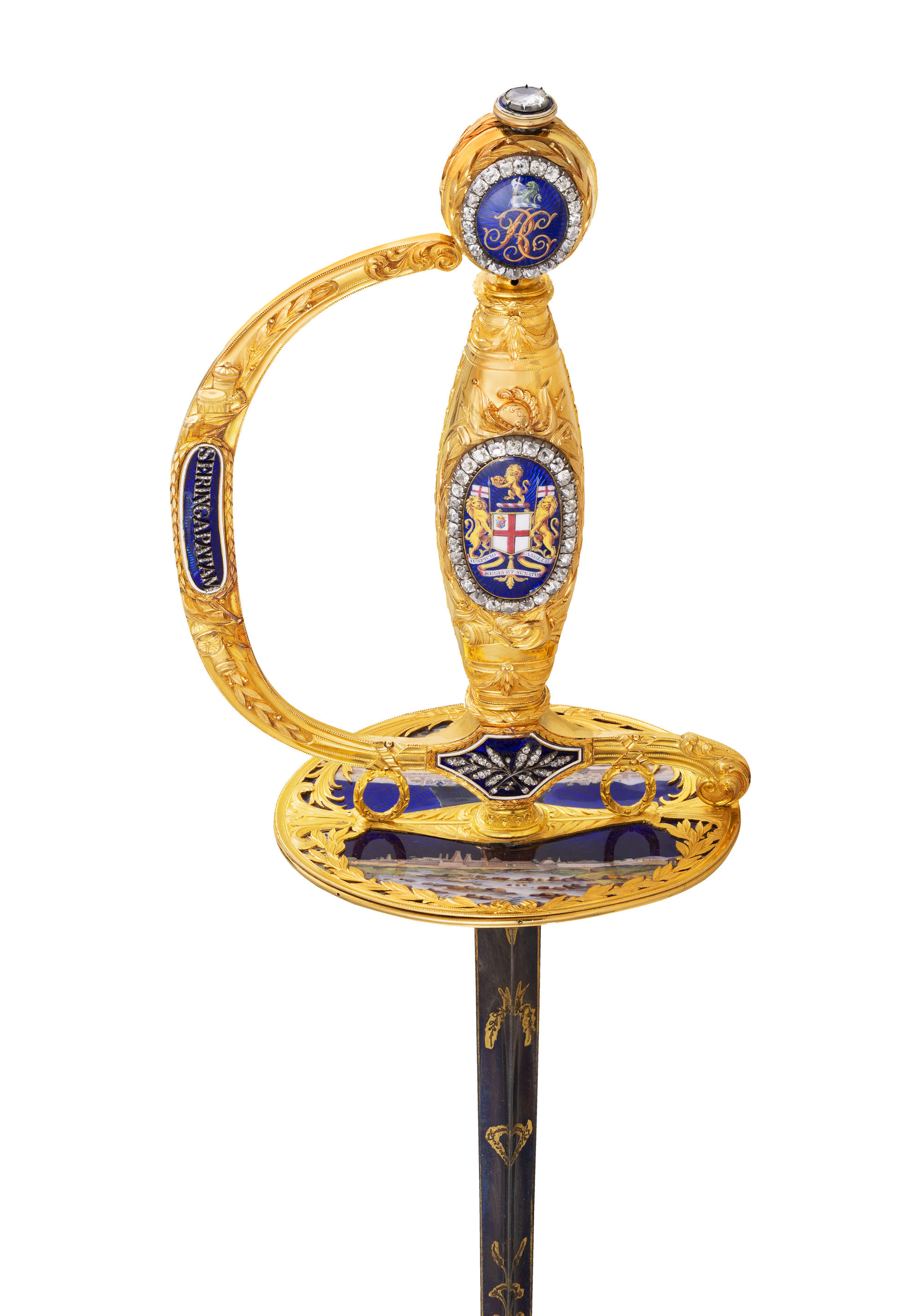
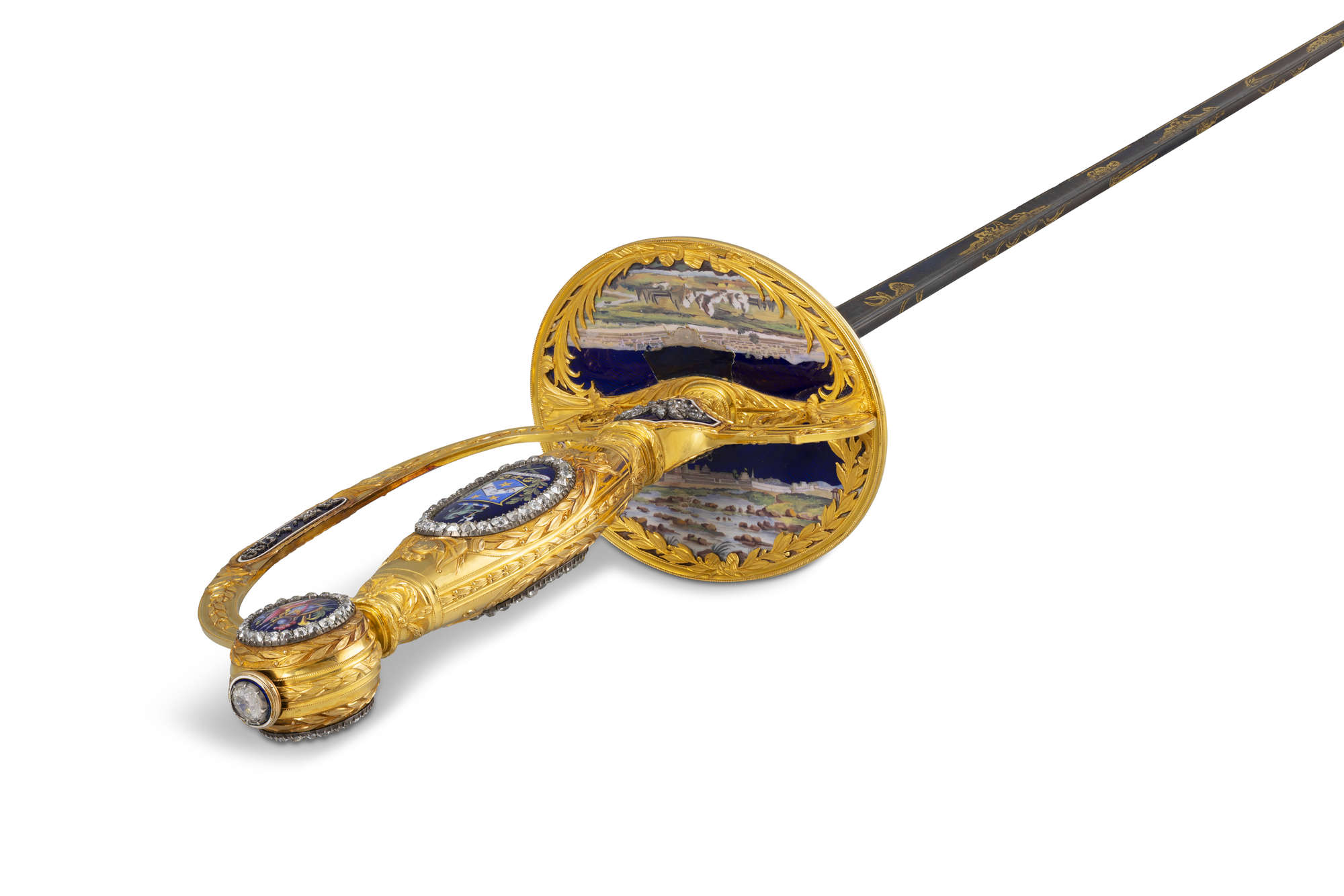
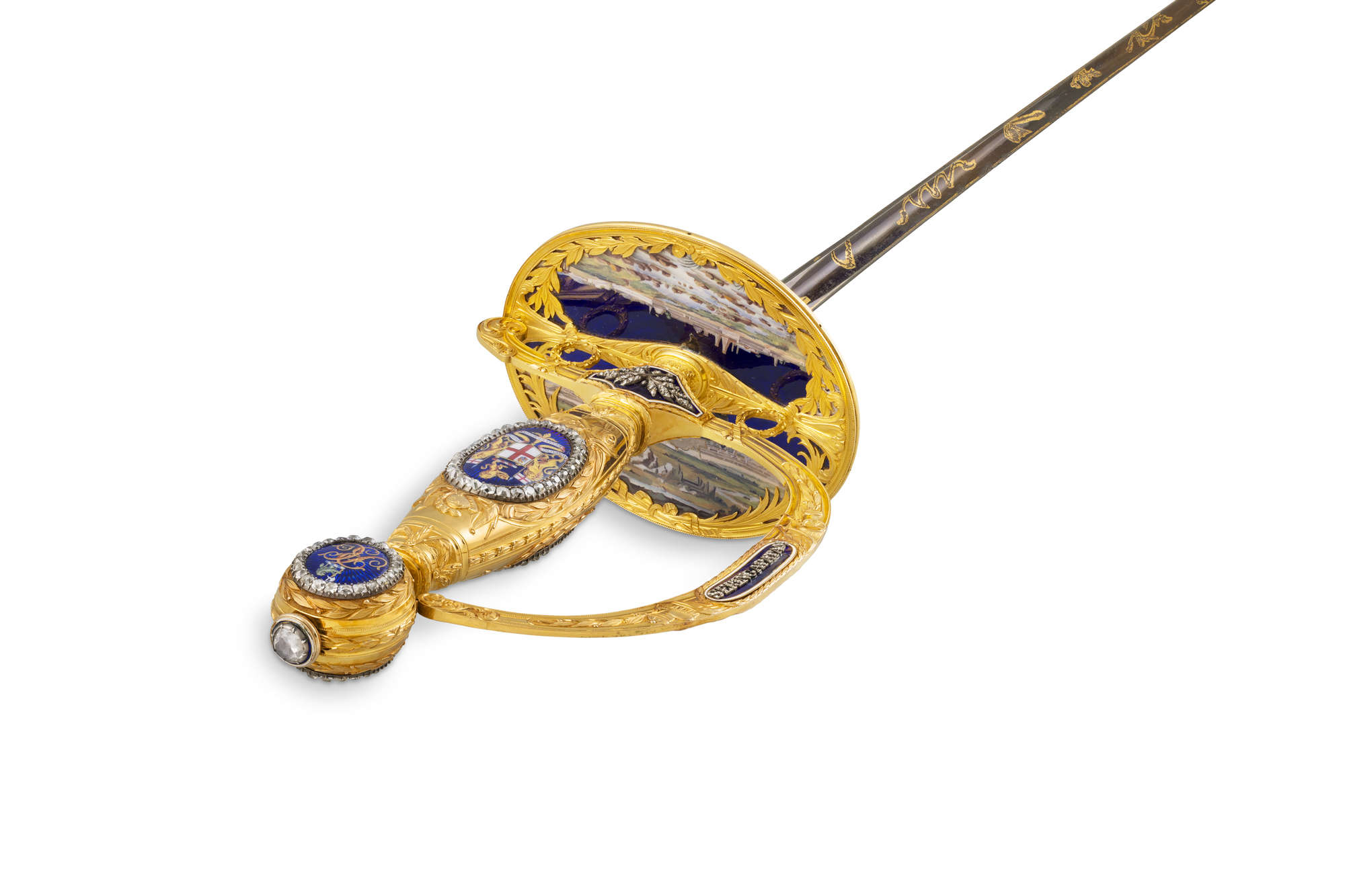
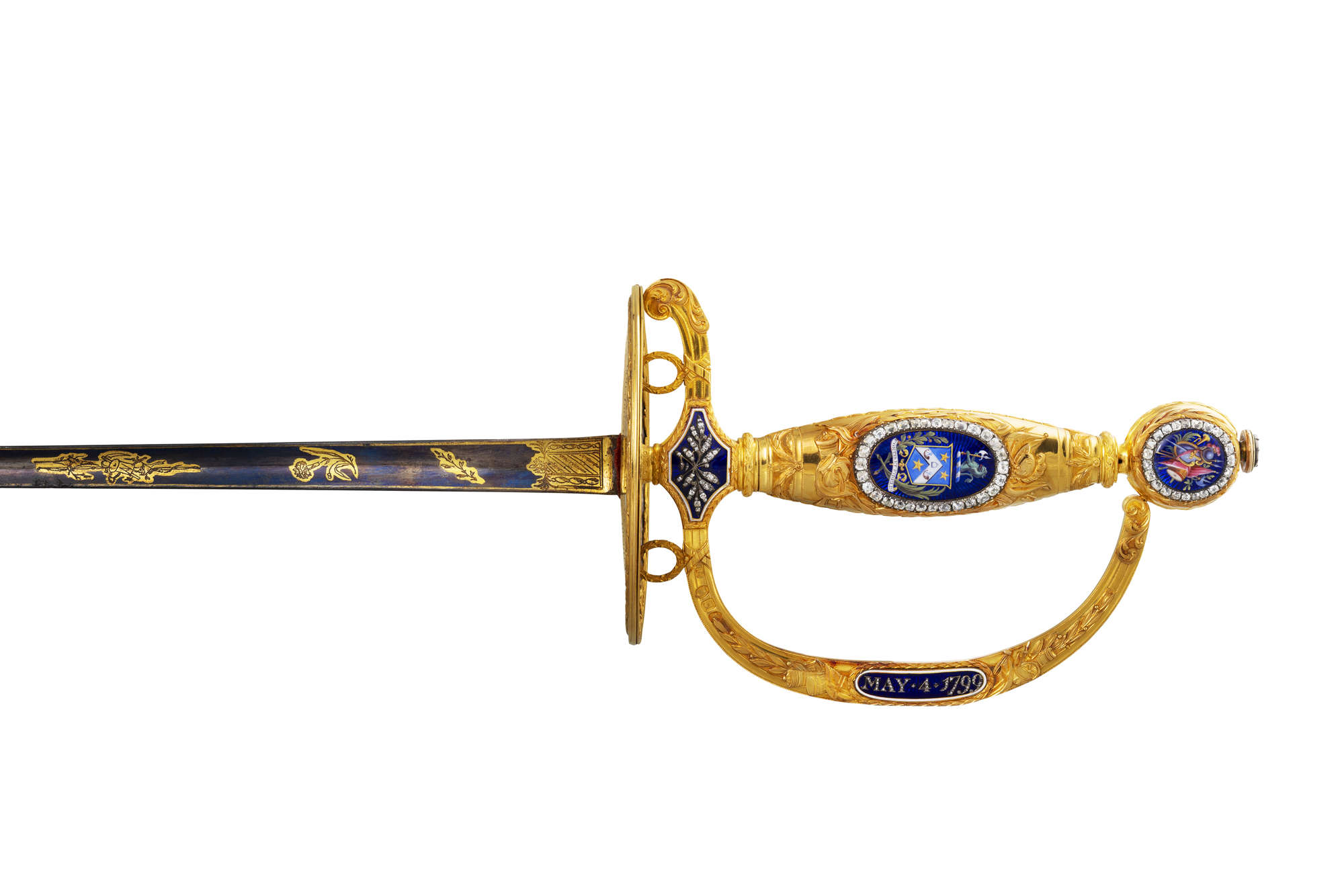
The faceted ovoid pommel cast with laurel sprays and surmounted by a rose-cut diamond, inset with blue enamel roundels over an engine-turned ground, bearing to one side the initials “BC” below a demi-lion vert holding a halberd, and to the other a trophy of arms, each bordered with twenty-three old cushion-shaped diamonds.
The grip of tapering ovoid form, cast and chased in relief with martial trophies of arms including a crested helmet, flags, drums and cannon barrels, the surfaces enriched with stippled and dotted grounds and framed by laurel sprays in high relief. Inset on either side with an oval enamelled armorial plaque reserved against translucent blue enamel over an engine-turned ground, each bordered with thirty old-cut cushion-shaped diamonds. One plaque depicting the arms of Lieutenant-Colonel Barry Close — a chevron between three hunting horns with stars in chief and base, surmounted by a demi-lion crest vert grasping a halberd, and with the motto Fortis et Fidelis (“Brave and Faithful”) beneath; the reverse depicting the arms of the Honourable East India Company, supported by lions and accompanied by the East India Company’s motto Auspicio Angliæ Regis et Senatus (“Under the auspices of the King and Senate of England”).
The straight cross-guard, with scrolling terminals and twin side-rings, inset on either side with an enamelled floral lozenge on a blue enamel engine-turned ground, each set with forty rose-cut and single-cut diamonds.
The knuckle-guard, a single arched bar of stirrup form, rising from the quillon block and curving in a smooth sweep to meet the pommel, chased in relief with cannon and standards, enamelled with cartouches on a translucent blue enamel engine-turned ground, set with diamonds spelling “Seringapatam” (approximately fifty-five rose-cut diamonds) to one side and “May 4 1799” (approximately forty-three rose-cut diamonds) to the other.
Total diamond weight: approximately 12.00–13.00 carats.
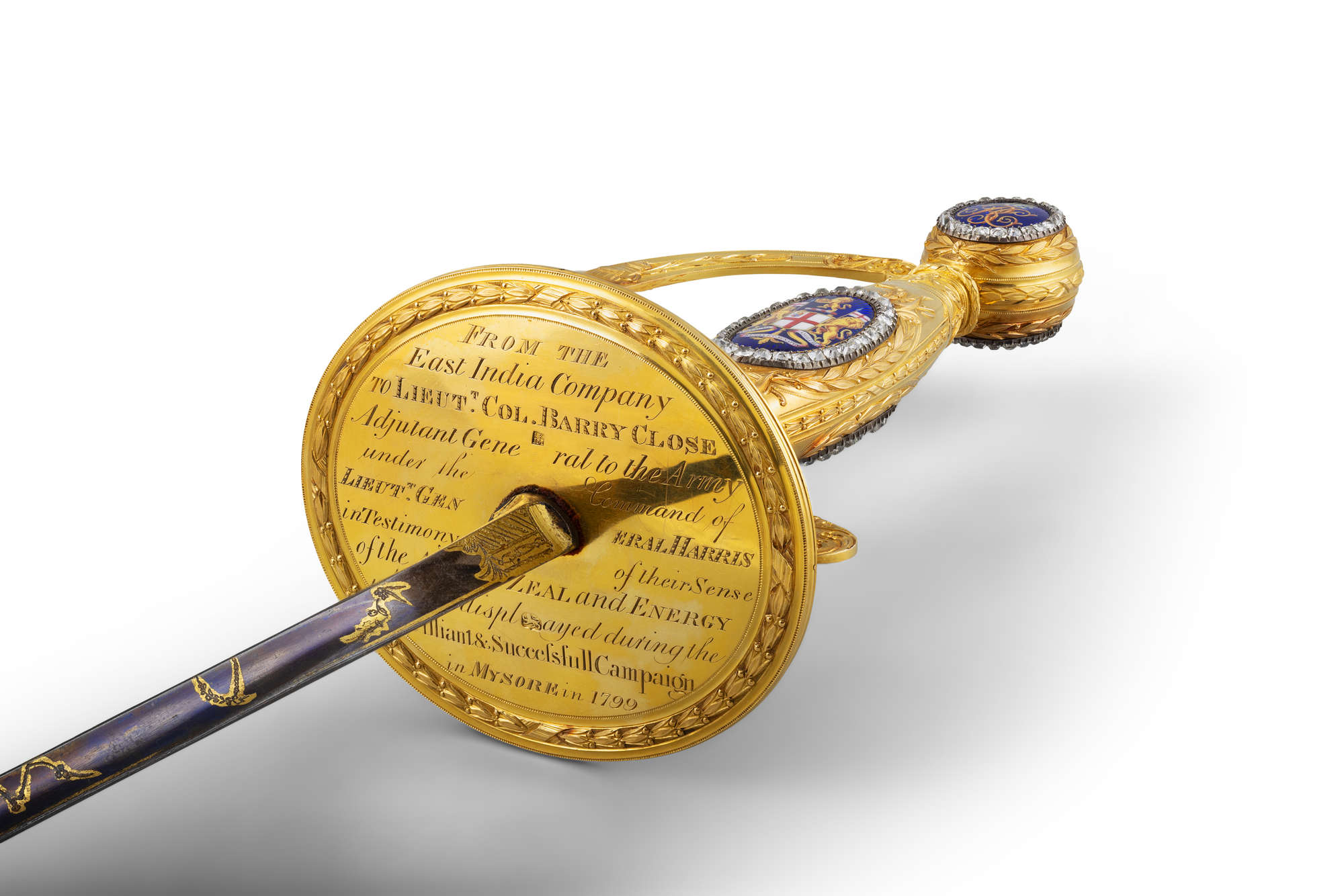
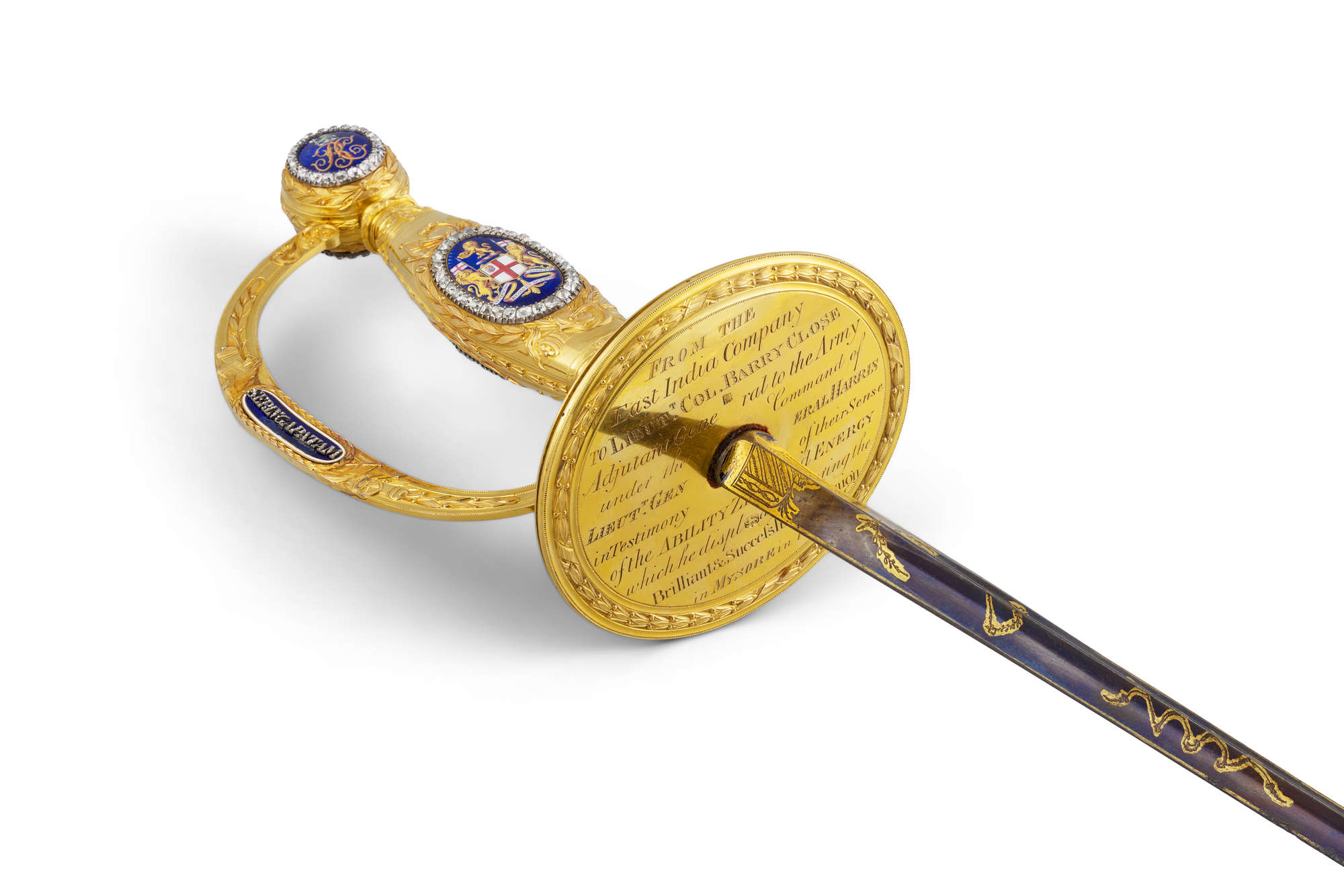
The gold oval shell guard with its outer face bordered by chased laurel leaves, decorated in blue enamel over an engine-turned ground and applied with painted enamel vignettes of the fortress of Seringapatam, one depicting the city walls and temples before bombardment, the other after the assault with the breached fortifications; the inner face engraved with the presentation inscription within a laurel border:
FROM THE, East India Company, To LIEUT. COL. BARRY CLOSE, Adjutant General to the Army, under the Command of, LIEUT. GENERAL HARRIS, in Testimony of their Sense, of the ABILITY, ZEAL and ENERGY, which he displayed during the, Brilliant & Successfull Campaign, in MYSORE in 1799.
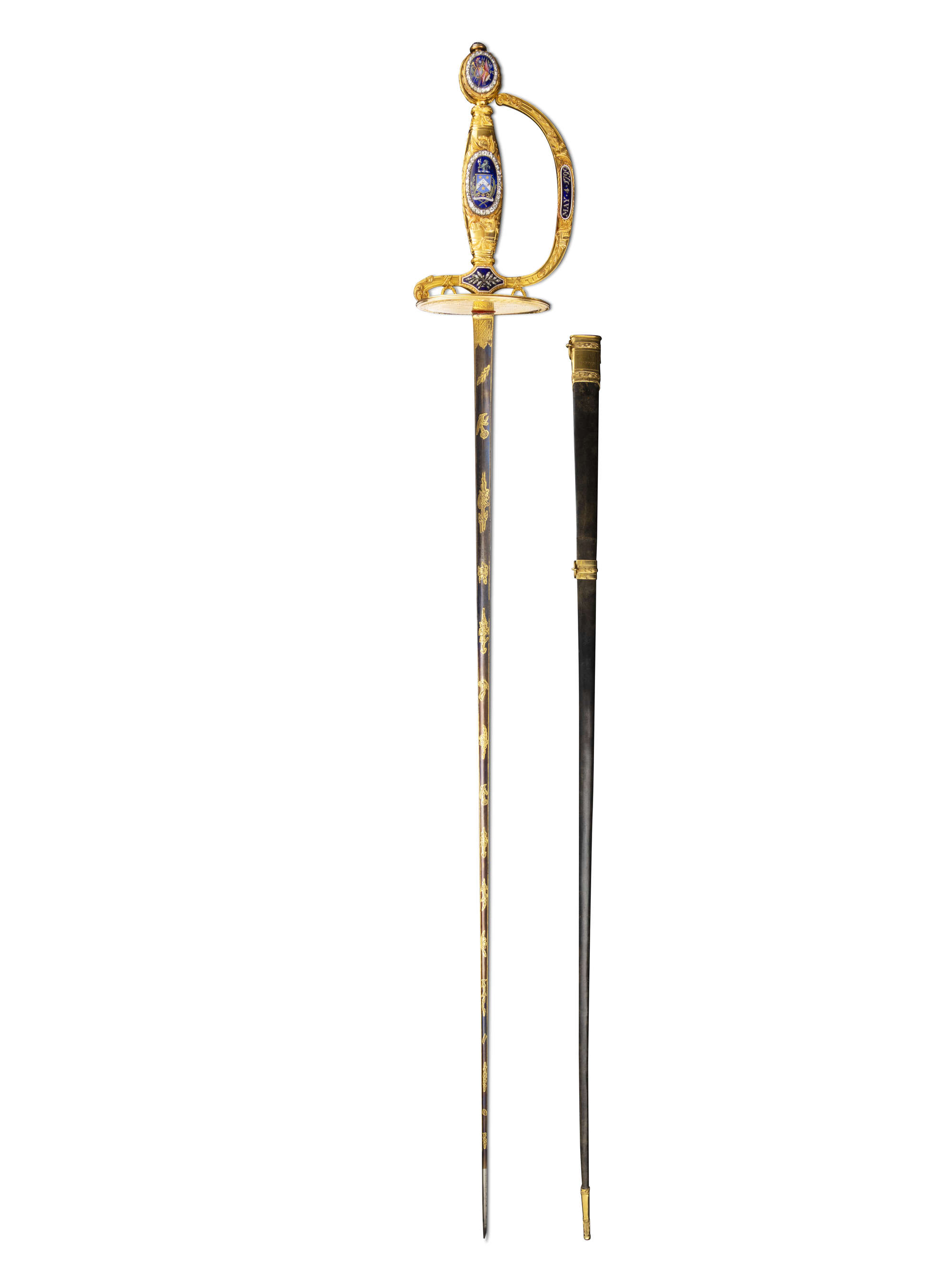
The steel blade of hollow-ground triangular section, finely blued and gilt, decorated at the forte with a rectangular gilt panel of linear and hatched ornament framed by foliate borders, the arrises highlighted in gilt, and the flats further gilt with scrolling foliate motifs against the blued ground, tapering to a point.
Blade 81cm (31½ "), overall 99.5cm (39¼"). With London assay marks and date-letter E (1800–01), maker’s mark of John Ray and James Montague.
The scabbard of wood covered in blackened leather, with gold locket, middle-band and chape, each chased with laurel swags in relief, the locket finely inscribed Green & Ward, London, fitted with suspension rings to locket and band.
The later leather-covered case, gilt-tooled to the lid Joseph Arden, Esq., the interior lined with velvet.
Provenance
Lieutenant-Colonel (later Major-General Sir) Barry Close, Bt. (1756–1813);
by descent through his family; acquired from the descendants of Barry Close, and thence by descent,
Together with;
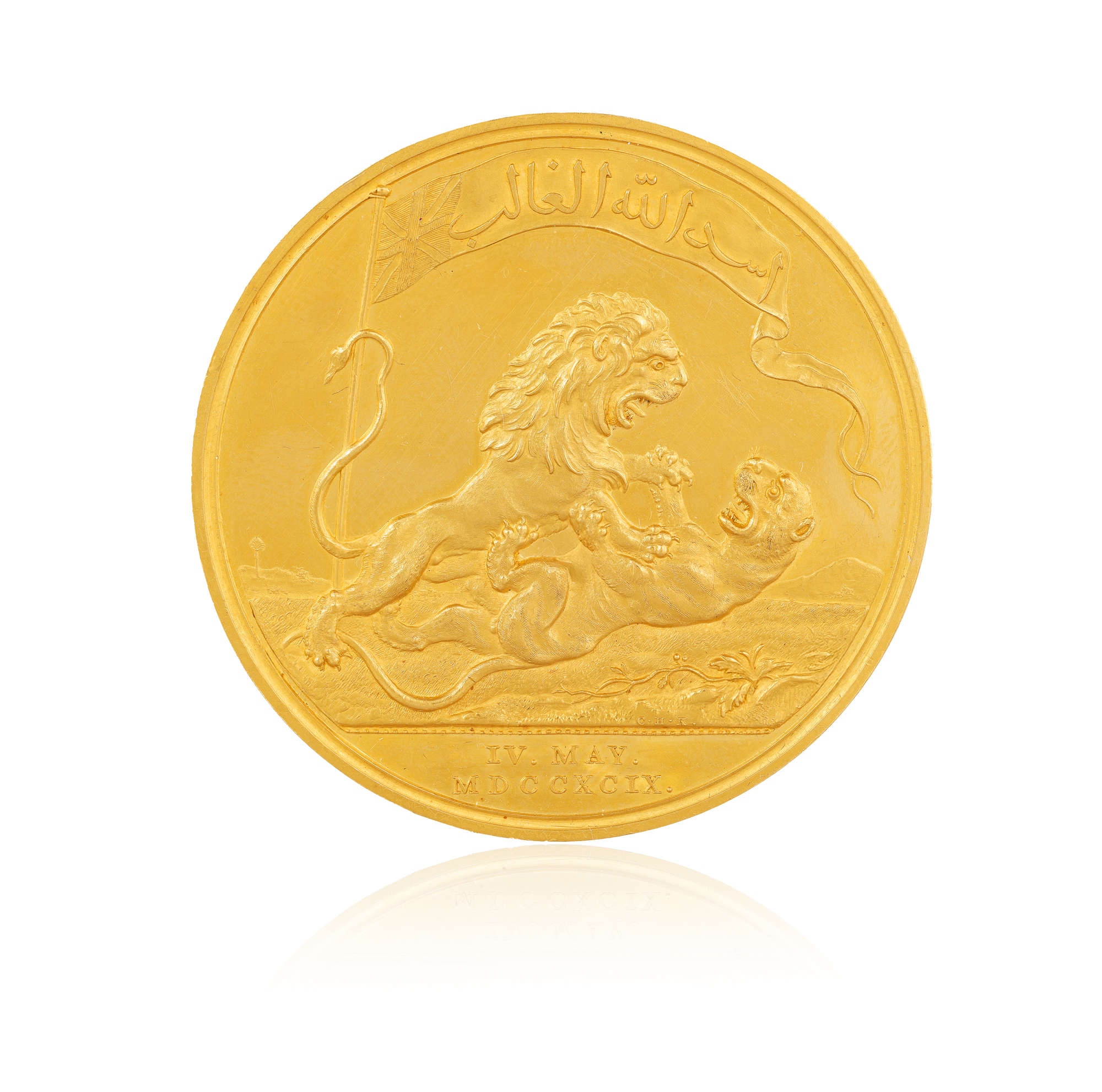
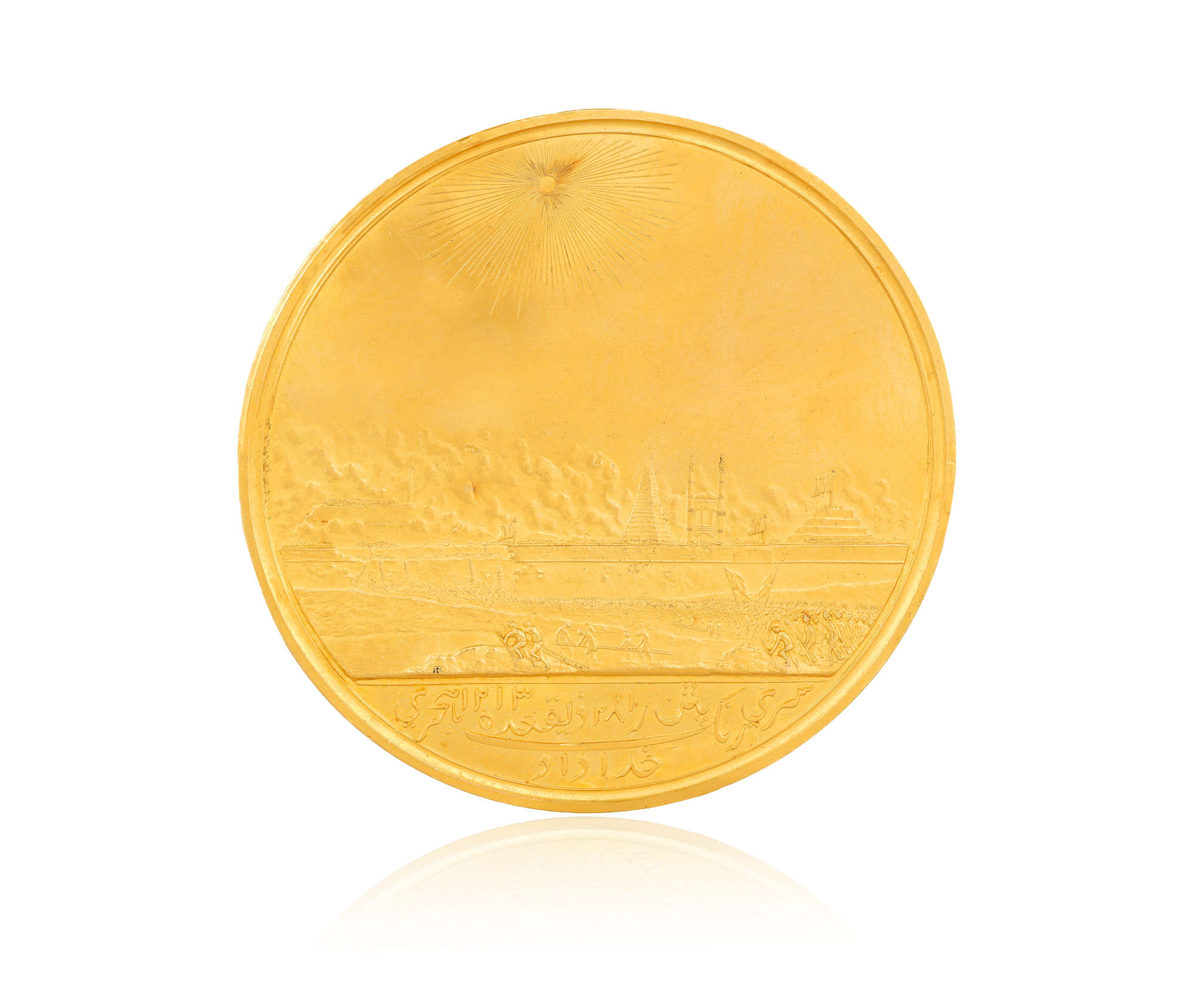
A SILVER-GILT SERINGAPATAM MEDAL BELONGING TO LIEUTENANT-COLONEL BARRY CLOSE (1756–1813), ADJUTANT GENERAL TO THE ARMY UNDER LIEUTENANT-GENERAL HARRIS England, circa 1801–02
Circular, depicting the British lion overcoming the tiger, above a standard inscribed in Arabic asadullah al-ghalib (“The Lion of God is Triumphant”), inscribed below IV MAY MDCCXCIX; the reverse showing a view of the fortress of Seringapatam with troops massing outside, with Persian inscription at the base; contained in a later circular red leather case, velvet lined.
The medal 4.8cm diameter, 59.1 g.
Provenance
Lieutenant-Colonel (later Major-General Sir) Barry Close, Bt. (1756–1813);
by descent through his family; acquired from the descendants of Barry Close, and thence by descent,
“The Tiger of Mysore has fallen, and with him an empire’s last hope.” So ran the cry at the storming of Seringapatam in 1799, when Tipu Sultan met his end and the East India Company claimed its greatest prize. With that victory the conquest of Seringapatam entered legend, and with it the rise of men like Sir Barry Close (1756–1813). This exceptional sword, crafted by the celebrated London makers Ray & Montague, was presented to Close for his gallantry in the Company’s campaigns against Tipu Sultan. A blade born of empire, honour and war, it remains a vivid reminder that “it was not by gold or silver, but by steel, that dominion was won in India” (James Mill, The History of British India, 1817).
The siege of Seringapatam was the decisive action in the struggle between the Company and its most formidable adversary, Tipu Sultan, the self-styled “Tiger of Mysore.” Tipu, who famously declared “I would rather live a day as a tiger than a lifetime as a sheep”, had waged four wars against the British and their allies. A brilliant general and innovative ruler, he modernised Mysore’s army with French assistance, established silk production, state trading networks, and introduced reforms that transformed the regional economy (see W. Kirkpatrick, Select Letters of Tippoo Sultan, London, 1811). On 4 May 1799, as the cannons fired their last shots and the waves of battle receded, Tipu lay dead amid a heap of wounded, killed fighting hand to hand in the press of combat. His fall brought an end to over three decades of resistance to the Company’s expansion in southern India.
The assault was led by General David Baird, with the left wing under the command of Colonel the Honourable Arthur Wellesley, later the Duke of Wellington. The storming of the walls, Tipu’s death, and the subsequent surrender of his sons became iconic subjects in British painting and literature, vividly captured in works by Mather Brown, Henry Singleton and others (Mildred Archer, India and British Portraiture 1770–1825, London, 1979, pp. 422–426). For the Company, victory was both strategic and symbolic. Mysore was partitioned, prize money distributed on a scale that reflected the magnitude of the conquest, the Commander-in-Chief receiving £100,000 while private soldiers were awarded £7 each (T.E. Hook, The Life of General, the Right Honourable Sir David Baird, 1832, pp. 231–232), and presentation swords of unprecedented value were commissioned for the campaign’s leading officers. Together with the 200-guinea sword awarded to Major-General Baird, the 300-guinea Close sword demonstrates the scale of the Company’s patronage and the ceremonial splendour through which it honoured its chosen servants.
John Ray and James Montague were established in partnership as goldsmiths, jewellers and sword-cutlers at 22 Denmark Street, Soho, from 1800 until 1821. Both had been senior craftsmen in the workshop of James Morisset (1738–1815), one of the most important goldsmiths and enamellers of the late eighteenth century. On Morisset’s retirement in 1800, they took over his premises, registering their joint maker’s mark “IR over IM” at Goldsmiths’ Hall on 4 May of that year. The firm’s recorded output was small: only around thirty swords bearing their joint mark are known today, together with a handful of freedom boxes, enamelled tokens and other gold “toys.” They did not operate a retail shop but worked for London’s leading jewellers, Rundell & Bridge, Jefferys & Gilbert, Robert Makepeace and Green & Ward among them, who in turn supplied the East India Company, civic bodies and colonial assemblies with presentation swords and regalia.
By the mid-eighteenth century, the small sword had become less a weapon of war than a jewel of rank and ceremony. Elaborate hilts in gold and silver, richly enamelled and set with diamonds, were the province of goldsmiths rather than sword-cutlers. Their splendour carried the symbolic weight of honour and reward, rather than the practical thrust of combat. The sword presented to Barry Close is among Ray & Montague’s earliest and most important works. Valued at 300 guineas, it was authorised by the Court of Directors on 7 May 1800 in recognition of Close’s services as Adjutant-General during the Mysore campaign. Completed in London, it was dispatched aboard the Mornington in December 1800 and formally presented to Close at Fort St George, Madras, in October 1801.
Together with Baird’s 200-guinea sword, it illustrates both the Company’s scale of patronage and the refinement of Ray & Montague’s workshop. Its lavish use of diamonds, enamel plaques and painted vignettes of Seringapatam extend the Morisset tradition of commemorative decoration into the new century. Other swords by the firm were made for Admiral Lord Keith (1801), Sir James Saumarez (1801) and the Duke of Gloucester (1801–02). Their last recorded sword was made for Admiral Lord Exmouth in 1816, after which the partnership was dissolved in 1821. Ray & Montague remain among the most celebrated goldsmiths and swordmakers of Regency London, their works encapsulating both the ceremonial splendour of the East India Company and the martial culture of Britain’s imperial expansion.
Barry Close entered the service of the East India Company in 1771 as a cadet in the Madras Army. A gifted linguist, he mastered Persian, Hindustani and Marathi, and soon earned a reputation as one of the Company’s most effective intermediaries with Indian rulers. Appointed Adjutant-General in 1790, he distinguished himself throughout the campaigns against Tipu Sultan, culminating in his role at Seringapatam in 1799. His organisational ability and steadiness under fire earned the admiration of his commander, Lieutenant-General Harris, and it was for these services that the Court of Directors resolved to present him with this 300-guinea sword, one of the most costly testimonial arms ever authorised by the Company. Close’s later career was equally distinguished. From 1801 to 1811 he served as Resident at Poona, where his diplomacy secured British influence over the Peshwa, and later as Resident at Hyderabad. Created a baronet in 1812, he died the following year, regarded as one of the Company’s most trusted soldier-statesmen during a transformative era in its rise to power (C.E. Buckland, Dictionary of Indian Biography, London, 1906).
The Barry Close sword is a key survival from this pivotal moment in British imperial history, one of only thirty recorded works by Ray & Montague and one of just two produced for the Mysore campaign. As an object it combines the artistry of Regency goldsmiths with the ceremonial theatre of the East India Company at its zenith. As a relic it embodies the fall of Tipu Sultan, the Company’s consolidation of power in southern India, and the honour bestowed upon one of its most loyal officers. Tipu’s death on the field, fighting to the last amid the smoke and carnage of his capital, lent the conquest of Seringapatam a mythic quality for contemporaries. If its opening cry was “The Tiger of Mysore has fallen,” then Barry Close’s sword preserves that moment still, a jewel of steel and enamel fashioned to commemorate victory and service.
All bids are placed in Euros (€)
Please note that by submitting a bid you are agreeing to our Terms & Conditions


 Have a similar item to sell?
Make Enquiry
Have a similar item to sell?
Make Enquiry